Last updated 2026-08-21
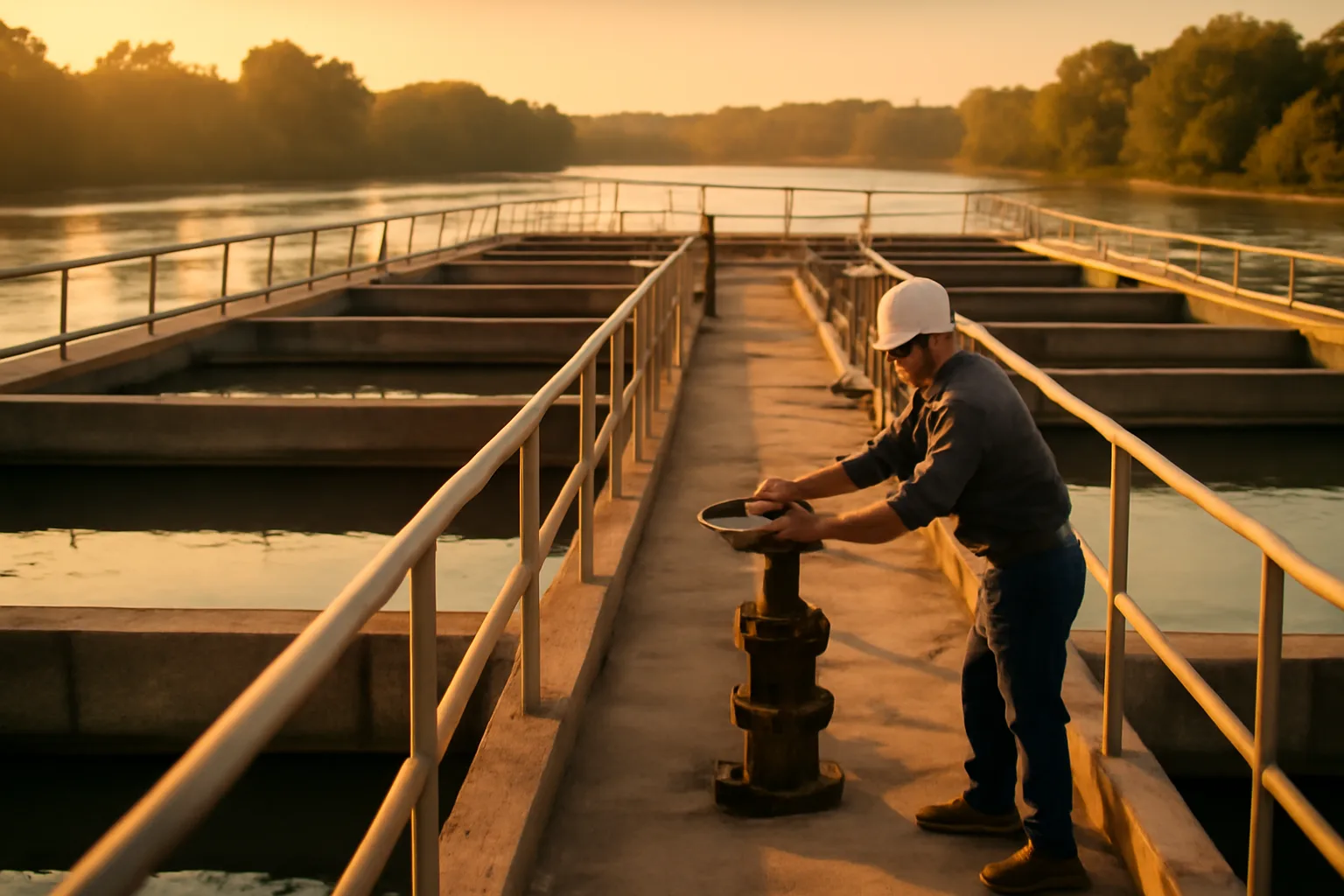
TL;DR
A water treatment operator runs the processes and paper that keep a drinking water plant inside EPA and state limits. States license the job, not the feds. You start with a high school diploma, a trainee seat at a plant, then the board exam for your grade. No national card exists. BLS put 2023 median pay at $54,890. Confirm every fee with your state board.
What is a water treatment operator?
A water treatment operator is the licensed plant person who turns source water into finished drinking water and keeps the records that prove the process stayed inside federal and state limits. You are not a plumber. You are not the lab director. You own the shift.
Most of this work sits at community water systems, meaning systems that serve at least 15 service connections or 25 people year-round. The federal contaminant limits you operate against live in the National Primary Drinking Water Regulations at 40 CFR Part 141 [6]. Surface water plants also sit under 40 CFR 141.70, which states that each system using surface water or groundwater under the direct influence of surface water "must be operated by qualified personnel who meet the requirements specified by the State and are approved by the State to operate such public water systems" [5].
Your day is pumps, chemical feed, filters, disinfectant residual, and logs. You jar-test when the river turns over. You chase a rising turbidity number at 2 a.m. You hold chlorine contact time. You call the superintendent when a coagulant pump fails. Half the job is process control. The other half is defensible records.
The Bureau of Labor Statistics groups water and wastewater treatment plant and system operators under SOC 51-8031, and reported a 2023 median wage of $54,890 [1]. That mix of drinking water and wastewater in one number is messy. Wastewater is a different license in most states. If you want potable water, tell the board you want a water treatment operator grade, not a wastewater grade.
States classify the plant and the operator together. A small groundwater chlorinator is not a conventional surface plant with sedimentation and filtration. Your grade has to match the plant class. That pairing is the point of the 1999 EPA operator certification guidelines that still sit under the Safe Drinking Water Act [4].
How do you start as a water treatment operator?
You start by getting a high school diploma or GED, landing a trainee or operator-in-training seat at a public water system, then sitting the entry exam your state board actually grades. There is no federal operator card you can print at home. The board that licenses the plant you work at is the only board that matters on day one.
Call that board before you pay a school. Ask three things. What is the lowest treatment grade? How much operating experience does that grade need, and what education can substitute? Which exam vendor do they use this year? Write the answers down. Boards change outlines and vendors. Confirm, do not assume.
Hire path beats course path for most people. Plants train you on their filters, their SCADA, their monthly operating report. A certificate with no hours in a real gallery does not move a board clock. If a community college water program is on your board's approved list, that can cut required months in some states. If it is not on the list, I would not pay for it.
Study the need-to-know criteria for the exact grade you will sit. Drill the math daily. Detention time, chemical feed, filtration rate, CT, unit conversions. Theory can wait until the last two weeks. I would not buy a $2,000 bootcamp that the board does not recognize. Waste of money.
File the application the way the board printed it. Transcripts, experience affidavits, exam score, fee. Never invent a processing time. Boards backlog. Your superintendent's signature on experience hours is usually the slow piece, not the envelope.
If you already know the state, jump to that board's paper. The California T1 to T5 treatment grades and the Texas cost breakdown are the two most common first clicks I get from new hires.
Is there a national water treatment operator license?
No. There is no national water treatment operator license that lets you legally operate a U.S. public water system by itself. Anyone selling a national card as a substitute for your state certificate is selling you nothing.
Congress put the floor in 42 U.S.C. 300g-8. That section tells EPA to publish minimum standards for certification and recertification of operators of community and nontransient noncommunity public water systems [3]. EPA did that in the Federal Register on February 5, 1999. States that fail to run a program meeting those guidelines risk a 20 percent withholding of Drinking Water State Revolving Fund money [4]. The federal hammer sits on the state, not on you.
What looks national is the exam. Many boards buy standardized water treatment exams and need-to-know outlines from Water Professionals International, the group that used to operate as the Association of Boards of Certification. Passing that exam still does not license you. The state certificate does.
Reciprocity exists in some states if your grade, exam, and hours line up. It is a petition, not a right. I have watched operators move and sit a lower grade again because the new board would not map the old one. Ask before you quit the job you have.
What education do you need before you sit the exam?
A high school diploma or equivalent is the typical floor. BLS says, "Water and wastewater treatment plant and system operators typically need at least a high school diploma or equivalent and a license to work" [1]. That matches what boards print. College is optional for entry grades.
Higher grades often trade education for months of experience. A water technology certificate or a related associate degree can shorten the clock. Only if your board lists that program or that substitution in rule. Random online CEU vendors do not automatically count as pre-exam education.
I would take a board-approved math and treatment course while I was already on payroll. Paying tuition before you have a plant that will sign your hours is backwards. The affidavit of experience is the document that stalls people, not the diploma.
GED is fine in the states I have read. If you are missing transcripts, fix that first. Boards will not score an exam they never admitted you to take.
Do not confuse operator school with a professional engineer license. PE stamps are a different statute. Operators run the plant. Engineers design it.
How long does water treatment operator certification take?
Entry grade can take a few months if you are already employed at a classified plant and your board lets trainees sit early. Higher grades often take one to four years of operating experience, sometimes less with education substitutions. Nobody publishes a clean national average. The clock lives in your state's classification table.
The honest range is wide because plant class, shift hours, and substitution rules differ. A T1-style or Class D-style card in a small groundwater system can move fast. A surface water grade that matches a conventional plant takes longer, because the board wants you to have seen coagulation, filtration, and disinfection under a certified operator.
Do not trust a school that quotes a fixed number of weeks to "become licensed." They do not sign your experience form. The board does. Confirm the current experience table with that board. It changes.
Exam seats fill. Some states run computer testing year round. Others still use paper dates a few times a year. Build the calendar after you have the eligibility letter, not before.
What is on the water treatment operator exam?
Expect source water, coagulation, flocculation, sedimentation, filtration, disinfection, corrosion control, residuals, laboratory methods, safety, and regulations, plus a lot of math. Standardized outlines from Water Professionals International break water treatment into those process blocks for Class I through IV style exams. Your state may use that outline or a state-written one. Get the outline the board names, not a generic quiz app.
Math is where people fail. Feed rates in mg/L and lb/day. Detention time. Filtration rate in gpm/ft2. CT. GPM to MGD. Percent removal. If you cannot do those cold, you are not ready. I would run 20 minutes of calculations every day for six weeks and leave the wordy process chapters for the end.
First-year operators overbuy highlight videos. If the board publishes sample questions, use those. If you want drills and CEU tracking in one place, the Water Op Exam and CEU Kit is a $149 one-time option. It does not replace the board outline, and it does not file your application.
Bring the calculator the board allows. Leave the rest in the car. Failed exams still cost the retest fee. Confirm that fee on the current board page before you schedule.
How much does it cost to get licensed?
Plan for an application fee, an exam fee, and later a renewal fee, all set by your state board. I will not invent a current dollar amount here, because boards change fee schedules. Confirm every number on the board's fee page before you write a check.
Beyond the board, budget a cheap scientific calculator, a used treatment textbook if you want paper, work boots, and maybe a community college course if it is on the approved list. I would not finance a private "national certification" package. Your plant may pay exam fees. Ask HR before you spend.
Pay ranges for the job itself are clearer than license fees. BLS put the May 2023 median at $54,890, with the OEWS 10th percentile at $36,390 and the 90th at $82,390 for SOC 51-8031 [1] [2]. Overtime on nights and weekends is how a lot of first-year operators beat the median. Local government shops dominate the employment count [1].
For state-level fee walks, use a board page, not a blog memory. The Arizona fees and timeline and what to budget in Tennessee writeups are built so you can compare line items against the live board schedule.
What is the difference between treatment and distribution licenses?
Treatment is the plant. Distribution is the pipes, tanks, and booster stations after the plant. Many states issue separate certificates. A water treatment operator grade does not automatically let you be the operator in charge of a distribution system, and the reverse is also true.
California is the clean example. Treatment is T1 through T5. Distribution is D1 through D5. You can hold both. You apply for each. Texas and Florida use Class D through A labels, then split water treatment, water distribution, and sometimes groundwater versus surface in the same occupational licensing shop [8] [10].
If you work at a package plant that also owns the mains, ask which certificate the designated operator of record must hold. That is the one to chase first. Collecting extra grades is optional until a job posting requires them.
Wastewater is a third pile of paper. Do not assume a wastewater Class B maps to a water treatment Class B. It does not.
What does first-year work at a plant actually look like?
First year is rounds, grab samples, chemical deliveries, and someone else's logbook format. You learn how that plant's clarifiers behave when the river rises. You learn which pump sounds wrong. You learn that the monthly operating report is a legal document, not a suggestion.
Chemicals you will actually touch depend on the process. Common ones are coagulants (alum or ferric), polymers, lime or soda ash, phosphate or silicate for corrosion control, and chlorine gas, hypochlorite, or chloramines. OSHA hazard communication rules in 29 CFR 1910.1200 apply to those SDS binders [14]. If you enter a tank, vault, or filter gallery that meets the definition, permit-required confined space rules in 29 CFR 1910.146 apply too [11]. I would not treat confined space as optional just because "we always do it this way."
SCADA is not magic. If the plant has it, you still walk the gallery. If it does not, you still walk the gallery. Weekend and night shifts are where you find out whether you like the work. I would take at least one stretch of nights early. The plant is a different machine at 3 a.m.
Do not buy your own colorimeter or pocket chlorine kit on day one. Match the plant's approved method first. Extra gadgets that do not match the SOP waste money, and they create two numbers in an argument.
Paper you will see in year one: shift logs, jar-test sheets, turbidity and residual sheets, coliform sample siting plans, chain of custody, and the monthly report that goes to the state. If you cannot explain a number you wrote, do not write it.
How do you renew a water treatment operator license?
You renew on the board's cycle with a fee and continuing education hours the board accepts. Hour totals often land somewhere in the 12 to 30 hour range per cycle, but that is a range, not your number. Confirm the current hour count, the approved provider list, and the late penalty with the board that printed your certificate.
Carry hours in the same name and license number the board has on file. Mismatched certificates are how people lose a cycle. Keep PDFs. Boards audit.
Safety, treatment process, regs, and ethics courses usually count. Sales pitches for a vendor's media usually do not. If your plant's in-house training is not on the approved list, it may still be good training and still fail a renewal audit.
Expired certificates get ugly. Some boards let you restore. Some make you retest. Do not guess. Read the restoration rule before you let a card lapse during a job gap.
Which state board do you contact first?
Contact the drinking water operator certification unit in the state where the plant is. Not the state you grew up in. Not the state on your online course receipt. The plant's primacy agency is the one that can put your name on a certificate that a sanitary survey will accept.
Grade labels are not interchangeable. Use the board's names, not ABC class numbers, when you fill an application.
| State | Who licenses treatment operators | Typical treatment grade labels |
|---|---|---|
| California | State Water Resources Control Board, Drinking Water Operator Certification Program | T1 through T5 |
| Texas | Texas Commission on Environmental Quality | Class D through A |
| Florida | Florida Department of Environmental Protection | Class D through A |
| Georgia | Georgia Environmental Protection Division | Class IV through I |
| Alabama | Alabama Department of Environmental Management | Grade I through IV |
Those grade letters are the usual pattern. Always confirm the live classification table. For process and cost detail, start with the Florida operator board, Georgia board process, Alabama ADEM path, or Colorado board writeups, then open the board's own form.
If you work across a state line on contract, you may need two certificates. Reciprocity is a filing, not a handshake.
Is the job shrinking, and should you still enter?
BLS projects employment for water and wastewater treatment plant and system operators to decline 6 percent from 2023 to 2033, from a base of about 126,600 jobs in 2023 [1]. Automation, consolidation of small systems, and contract operations are the usual reasons people give. BLS still treats a high school diploma plus a license as the entry path [1].
I would not skip the trade over that minus 6 percent if you already live near plants hiring trainees. The projection is national. It does not tell you whether the surface plant in your county has three operators over 55. Nobody has good public vacancy data at the county level. The closest official picture is still that BLS occupational page.
What I would not do is move across the country for an entry trainee seat you have not been offered in writing. Get the job, then get the grade. The certificate follows the hours.
WaterTreatmentPath is an independent publisher, not a law firm and not a service company. Nothing here is a filing, an approval, or a timeline promise. If you want the optional exam and CEU kit after you have the board outline, that path is at /start. Your board still owns the license.
Frequently asked questions
What is a water treatment operator?
A water treatment operator is the state-licensed person who runs a drinking water plant's processes and compliance records. You control coagulation, filtration, disinfection, and pumping so finished water meets 40 CFR Part 141 limits. BLS groups the job with wastewater under SOC 51-8031 and reported a $54,890 median wage in 2023. Your legal title is the grade your state board printed.
How do you start as a water treatment operator?
Get a high school diploma or GED, then apply for a trainee seat at a public water system. Ask the state board which entry grade you can sit and how much experience it wants. Study that grade's need-to-know outline, pass the exam, and file the application. Do not buy a fake national card. Confirm fees with the board before you pay a school.
Is there a national water treatment operator license?
No. EPA sets minimum standards for state programs under 42 U.S.C. 300g-8, but the certificate that lets you operate a plant is issued by the state. Standardized exams used by many boards are still not a license. Reciprocity is a separate petition. Confirm with the board in the state where the plant sits.
Do you need a college degree to be a water treatment operator?
No. BLS lists a high school diploma or equivalent as typical, plus a license. Higher grades in many states let you substitute a water technology certificate or related degree for part of the experience clock. Only board-recognized programs count. Confirm substitutions in your state's classification table before you enroll.
How long does it take to get a water treatment operator certificate?
Entry grades can take a few months if you are already employed and eligible to sit. Higher grades often take one to four years of operating experience, sometimes less with education substitutions. There is no honest national average. Exam calendars and affidavit processing also vary. Confirm the current experience table with your board.
What is the difference between water treatment and water distribution operators?
Treatment operators run the plant processes that produce finished water. Distribution operators run mains, tanks, and boosters after the plant. Many states issue separate certificates, such as California's T grades versus D grades. Holding one does not automatically grant the other. Ask which certificate the operator of record must hold at your site.
Are wastewater and water treatment the same license?
Usually no. Most boards run separate wastewater and drinking water treatment certificates, even when class letters look alike. BLS wage numbers mix both jobs in SOC 51-8031, which is why pay stats are a blend. If you want potable water work, apply for the drinking water treatment grade your board names.
How much does the water treatment operator exam cost?
Exam, application, and renewal fees are set by each state board and they change. I will not quote a stale dollar figure. Read the current fee schedule on the board website before you pay a third party. Ask your plant whether it reimburses. Extra national certificates are not a substitute for the state fee.
Can you take the exam with no plant experience?
Sometimes for the lowest grade, if the board allows it. Many states still want you employed as a trainee or want a minimum number of operating hours before they issue the certificate, even if they let you sit early. Eligibility and issuance are different steps. Confirm both with the board that will print the card.
How often do you renew a water treatment operator license?
Renewal cycles are set in state rule, often every two or three years, with continuing education hours the board accepts. Hour totals commonly fall in a 12 to 30 hour range, but that is not your number. Confirm hours, approved providers, and late fees with your board. Keep completion PDFs under the same license number.
What chemicals do first-year water treatment operators handle?
It depends on the plant. Common process chemicals include alum or ferric coagulants, polymers, lime or soda ash, corrosion inhibitors, and chlorine gas, hypochlorite, or chloramines. OSHA hazard communication rules apply to the SDS file. Confined space rules can apply when you enter tanks or vaults. Follow the plant SOP, not a video.
Will automation replace water treatment operators?
BLS projects a 6 percent employment decline from 2023 to 2033 for the combined water and wastewater operator group, in part from automation and consolidation. Plants still need a licensed person who can take over when a sensor lies. The projection is national. Local retirements still open trainee seats. Confirm hiring with plants near you, not with a headline.
Sources
- U.S. BLS Occupational Outlook Handbook, Water and Wastewater Treatment Plant and System Operators: 2023 median pay $54,890; high school diploma typical plus a license; about 126,600 jobs in 2023; 6 percent projected decline from 2023 to 2033
- U.S. BLS Occupational Employment and Wage Statistics, May 2023, SOC 51-8031: May 2023 wage percentiles for water and wastewater treatment plant and system operators, including 10th percentile $36,390, median $54,890, and 90th percentile $82,390
- 42 U.S.C. 300g-8, Operator certification (Safe Drinking Water Act): EPA must publish Federal Register guidelines specifying minimum standards for certification and recertification of operators of community and nontransient noncommunity public water systems
- Federal Register, Final Guidelines for the Certification and Recertification of the Operators of Community and Nontransient Noncommunity Public Water Systems (Feb. 5, 1999): 1999 EPA operator certification guidelines that state programs must meet, including the 20 percent DWSRF withholding consequence
- 40 CFR 141.70, General requirements (Subpart H): Surface water and GWUDI public water systems must be operated by qualified personnel who meet State requirements and are approved by the State
- 40 CFR Part 141, National Primary Drinking Water Regulations: Federal drinking water standards and treatment technique rules that operators must meet at public water systems
- Texas Commission on Environmental Quality, Water Operator Licensing: TCEQ licenses public water system operators in Texas, including water treatment operator classes
- Florida Administrative Code Chapter 62-602, Water or Domestic Wastewater Treatment Plant Operators and Distribution System Operators: Florida rule chapter that classifies operators and sets certification requirements
- OSHA 29 CFR 1910.146, Permit-required confined spaces: Permit-required confined space standard that applies when operators enter qualifying tanks, vaults, or similar spaces
- OSHA 29 CFR 1910.1200, Hazard Communication: Hazard communication standard covering SDS and chemical hazard information for process chemicals operators handle