Last updated 2026-08-21
TL;DR
A water treatment operator runs the processes that make drinking water meet federal and state rules. There is no national license. Your state board issues the certificate after education, exam, and experience rules that change by grade. Pick the state and grade, sit the exam the board accepts, and log hours a certified operator will sign. Confirm every fee with that board.
What is a water treatment operator?
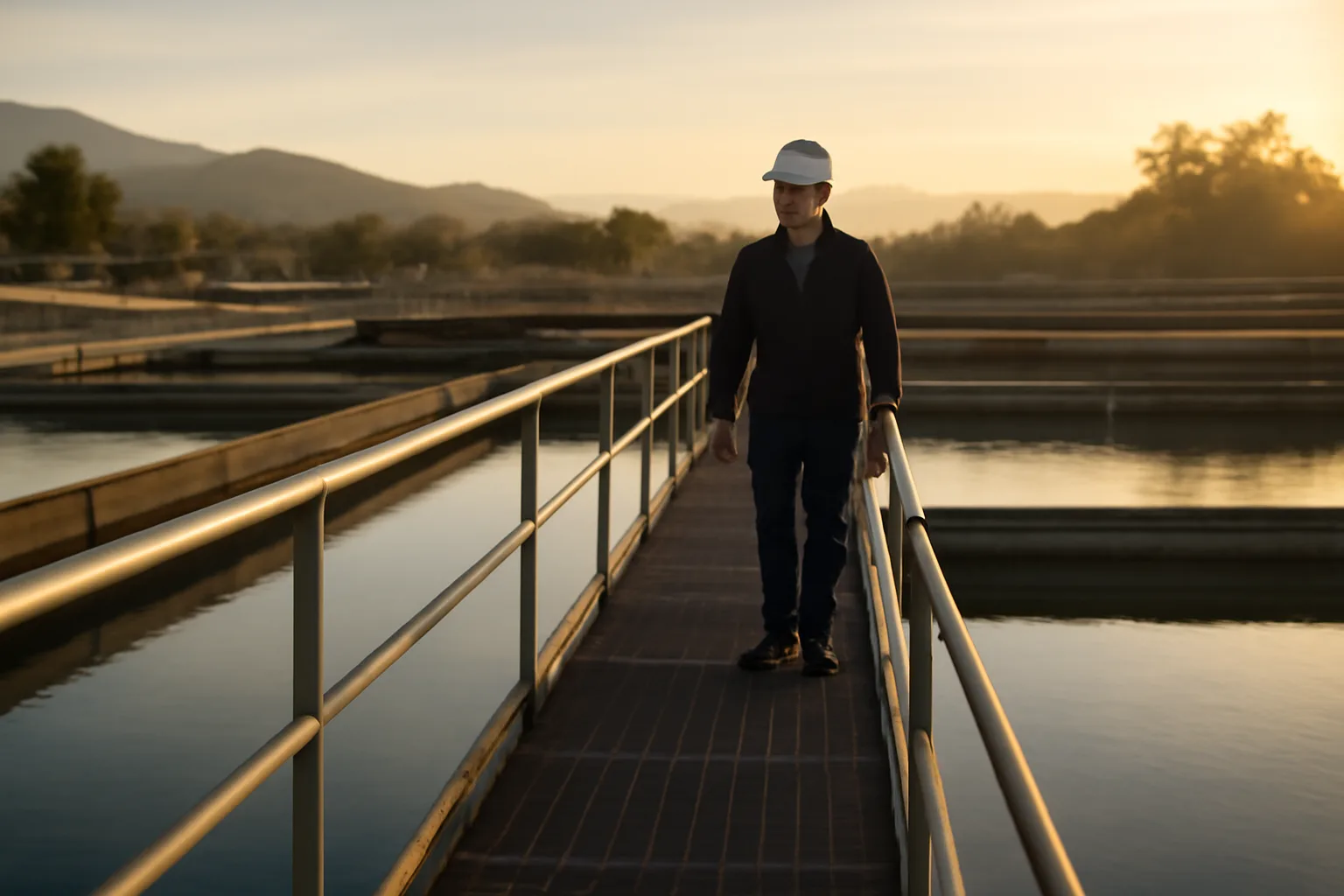
A water treatment operator runs the plant processes that take raw water from a river, lake, well, or reservoir and turn it into water that meets federal and state drinking water rules. You watch pumps, chemical feeds, filters, and disinfectant residual. You write the log. You stop a process when a reading is wrong.
The Bureau of Labor Statistics files drinking water and sewer plant staff under one occupation, Water and Wastewater Treatment Plant and System Operators (SOC 51-8031). That bucket exists for labor stats. It is not a license. [1]
Federal law does not hire you. The Safe Drinking Water Act pushes states to certify operators of community and nontransient noncommunity public water systems. Your paycheck usually comes from a city, a water district, a private utility, or a contract operations firm. Your certificate comes from a state board. [3]
On a small groundwater system you might be the only certified person, covering wells, chlorine, and a tank. On a large surface water plant you might spend a year on one filter gallery. Both count as operator work if your board says the hours count.
EPA’s public water system definitions decide whether a site even needs a certified operator. 40 CFR 141.2 states: "Community water system means a public water system which serves at least 15 service connections used by year-round residents or regularly serves at least 25 year-round residents." [10] Community systems and nontransient noncommunity systems sit inside the certification net. Transient systems (campgrounds, some rest stops) often get treated differently. Confirm the classification on the system’s PWSID record, not a guess from the front gate. [11]
How do you start as a water treatment operator?
You start by picking a state, then a grade, then an exam. There is no federal application. Call it a paper path, because that is exactly what it is: a diploma, an exam ticket, an experience affidavit, and a fee the board sets.
Get a high school diploma or GED first. BLS lists that as the typical entry education for this occupation, with long-term on-the-job training after you are hired. [1] Some boards let you sit the lowest exam with little or no experience. Others make you work under a certified operator before they will even schedule you. Texas built Class D as an entry water license. California talks about T1 as a treatment entry grade. Those names do not transfer on their own. [6] [7]
Get hired, or get a trainee slot. Boards count hours a certified operator will sign. They rarely count "I watched YouTube." If you cannot get hired yet, some states still let you take the lowest exam so you are easier to hire. Confirm that in writing with the board. I would not pay a private mill for a "national operator credential." It will not replace the state card.
Sit the exam your board names. Submit the form the board actually uses. Attach the diploma, the score report, and the experience verification. Pay the fee on the current fee schedule. I will not quote a board fee here. Boards change them. Confirm with the relevant board. Nothing in this guide is an approval or a timing guarantee.
If you want exam math, process review, and later CEU hours in one pile, WaterTreatmentPath sells a $149 one-time Water Op Exam + CEU Kit at /start. You do not need it to apply. The board does not require any vendor.
Is there a national water treatment operator license?
No. There is no national water treatment operator license in the United States.
Congress put operator certification on the states. 42 U.S.C. § 300g-8 says: "The Administrator shall publish guidelines in the Federal Register specifying minimum standards for certification (and recertification) of the operators of community and nontransient noncommunity public water systems. The guidelines shall take into account existing State programs, if any, for certification and recertification of the operators of such systems." [3]
EPA published those final guidelines on February 5, 1999. States that did not put a matching program in place risked losing 20 percent of their Drinking Water State Revolving Fund capitalization grant money. [5] That stick points at state programs. It is not a federal operator card.
Standardized ABC-style exams (now tied to Water Professionals International) get mistaken for a national license all the time. They are not one. Passing that exam only matters if your state board says the exam satisfies its rule. Reciprocity is a separate paper review. I have watched people move, assume the card ports, and show up unlicensed. Do not do that.
Tribal systems and some federal facilities can sit under a different primacy agency. Ask who issues the certificate before you study for the wrong outline.
What education and experience do boards actually require?
Most boards start with a high school diploma or GED. BLS lists a high school diploma or equivalent as the typical entry-level education, plus long-term on-the-job training. [1] A college degree can substitute for part of the experience clock in some states. It is not the usual door.
Experience is where people stall. States classify plants by source, treatment type, and size, then require the designated operator in charge to hold a matching grade. Your hours have to match that classification. Mowing the lawn at the plant rarely counts. Filling a fluoride hopper under a certified operator often does. Read the experience definition in your operator regulation. Skip the forum summary.
College-for-experience swaps exist in some states and not others. Nobody has a clean, current 50-state table that boards will honor. Anyone selling one is selling. Confirm substitutions with the board that will print your number.
| State | Who issues the card | How grades are usually described |
|---|---|---|
| California | State Water Resources Control Board | Treatment T grades, separate distribution grades |
| Texas | TCEQ | Water operator classes, often discussed as D through A |
| Florida | Florida DEP | Classes tied to plant category, water and wastewater in one program office |
| New York | State Department of Health | Grades tied to system classification |
California’s drinking water operator certification program is run by the State Water Resources Control Board. [6] Texas water operator licensing sits at TCEQ. [7] Florida’s water and domestic wastewater operator certification program is at DEP. [8] New York certifies community and NTNC operators through the State Department of Health. [9]
I would not bank random CEUs before you have a certificate number. Some boards will not apply them backward.
Which exam will you sit, and who writes it?
You sit the exam your state board names. That is the whole answer.
Many states buy standardized water treatment exams built around Need-to-Know content (process control, disinfection, labs, safety, math). Other states write items in house. California’s exams are California’s. Florida’s program is Florida’s. [6] [8]
Expect multiple choice. Expect water math: detention time, chemical feed rate, filtration rate, chlorine demand and residual. Expect questions on a conventional surface water train even if you work at a well site. Study the outline the board posts. Do not read a 400-page encyclopedia cover to cover on week one.
I would buy one good math workbook and the state regulation packet. I would not buy three competing "national" prep courses. Sacramento State’s Office of Water Programs manuals are still the books a lot of plants keep on the shelf, and they match how operators talk on shift. [12]
Scheduling runs through the board or a testing vendor the board names. Bring the ID the bulletin lists. If you fail, most boards let you retest after a wait. Confirm the wait. I will not invent it.
How much do water treatment operators make?
Pay is local. BLS is the honest national snapshot, not your offer letter.
BLS reported a national median annual wage of $54,890 for Water and Wastewater Treatment Plant and System Operators based on May 2023 Occupational Employment and Wage Statistics. Check the live Occupational Outlook Handbook and OEWS tables, because BLS revises them. [1] [2]
Nobody has good public data that splits drinking water operators from wastewater operators inside SOC 51-8031. The closest source is still BLS, and it mixes the two. [1]
Shift differential is real at many union plants and absent at a one-person groundwater system. Overtime during a boil-water notice is where some annual totals jump. Public employers post ranges on civil service pages. Read those. Contract operations firms bid cities, and the wage follows the contract, not a national myth.
I would not relocate for a $2,000 gap. I would relocate for a higher-grade slot if your home board has you frozen as a trainee.
What does a first year on shift actually look like?
Your first year is rounds, logs, and not touching a setpoint you do not understand.
You walk the plant. You read gauges. You collect turbidity, pH, chlorine residual, and whatever else the sample schedule lists. 40 CFR Part 141 is the federal rule book those results live under. [10] State rules can be tighter. The certified operator in charge owns process changes until your grade says you do.
Expect early mornings, holidays, and a phone that rings when a pump faults at 2 a.m. Small systems are more on-call. Large plants have relief shifts.
The paper you produce in year one is what an inspector will ask for. Chain of custody. Monthly operating reports. Coliform sample siting. Jar test notes if you run them. A pretty SCADA graphic does not replace a signed log.
Safety is not a poster. Chlorine gas, confined space in a clearwell, fall protection on a basin wall. Your employer owes you the training that matches those hazards. I am not going to pretend a paragraph can stand in for that course.
Treatment, distribution, or wastewater: which license first?
Get the certificate that matches the job. Mixing them up wastes a year.
Treatment is the plant: coagulation through disinfection, membranes, groundwater treatment, residuals. Distribution is pipes, tanks, boosters, and keeping a residual out in the system. Wastewater is the other fence line. Many states issue separate certificates. Some issue a water license that still splits treatment from distribution inside the grades. [6] [7]
BLS lumps water and wastewater operators together for statistics. Your board does not. [1]
If the posting is a membrane surface water plant, you want treatment. If it is a consecutive system with no treatment, you want distribution. Ask the superintendent which certificate the designated operator in charge must hold. Then apply for that one.
Wastewater hours often do not count toward drinking water grades, or they count at a reduced rate. Confirm with the board. I would not assume they count.
How long does licensing take, and what slows it down?
It takes as long as your state’s experience clock and exam calendar say. There is no national number. I will not invent one.
Lowest grades can be diploma plus exam in some states, with a certificate once the board processes a complete file. Higher grades can take years of signed experience. California and Texas both expect you to climb grades rather than jump from the street to the top class. [6] [7]
What slows people down is an incomplete application, hours the board will not accept (wrong system type, unsupervised time, missing signatures), and waiting to study until the week of the test. What does not slow you down is a fancy binder.
Boards get behind. Flood years get behind. Confirm processing with the relevant board. No approval or timing guarantees.
What paperwork should you keep in year one?
Keep a file an inspector could copy without hunting through your texts.
Diploma or GED. Exam result letter. The certificate (and a photo of it stored off-site). Experience verification forms. The plant monitoring plan and the Part 141 results you touched. [10] Calibration logs for turbidimeters and chlorine analyzers. Shift logs with your signature. Training slips the board might later accept as CEUs.
Email is not an archive. Print the certificate when it arrives. If your state posts an online roster, save your status the day it goes active.
I would keep a personal hours log even if the utility tracks time. When you apply for the next grade you will want dates, system name, PWSID, and the grade of the operator who supervised you. New York and other primacy agencies care about system classification more than "I worked at a plant." [9]
What happens after you pass (renewal and CEUs)?
Passing is not the end of the paper. Certificates expire. States require continuing education and a renewal application.
CEU hours, cycle length, and fees are state rules. Do not borrow another state’s hour count. Florida, California, and Texas each run their own renewal clock. [6] [7] [8]
For the state paper after you are licensed, use a state guide, not a national checklist. Start with Water treatment operator renewal in Texas: the complete guide or water treatment operator renewal in california if that is your board. Alabama, Arizona, and Florida are the same problem with different forms: Alabama water treatment operator renewal: what ADEM requires, Arizona water treatment operator renewal: fees, CEUs, and timeline, and water treatment operator renewal in florida. Colorado, Georgia, and Connecticut have their own CEU math too: water treatment operator renewal in colorado, water treatment operator renewal in georgia, and CT water treatment operator renewal: CEUs, fees, and requirements.
Lapsed certificates can force a retest. Set a reminder 90 days before expiration, not 9.
What would I do (and skip) if I were starting tomorrow?
If I were starting tomorrow I would download my state operator regulation and the exam content outline. I would apply to every nearby trainee posting that names a certified operator on staff. I would practice water math until detention time and feed rate are boring. I would confirm the current fee and form on the board site the week I apply.
I would skip paid "national operator ID" websites. I would skip used exam dumps. I would skip waiting for a perfect bachelor’s in environmental engineering. BLS describes this occupation as a diploma plus long-term on-the-job training. That matches how most plants actually hire. [1]
WaterTreatmentPath is an independent publisher, not a law firm and not a service company. If you want exam and CEU materials in one pile, the $149 Water Op Exam + CEU Kit is at /start. Your board still has the last word on the card.
Frequently asked questions
What is a water treatment operator?
A water treatment operator runs the processes that turn raw water into drinking water that meets federal and state rules. You monitor pumps, chemicals, filters, and disinfectant residual, and you keep the logs an inspector will ask for. The state board, not EPA, issues the certificate. BLS tracks the work under SOC 51-8031 with wastewater operators, which is a labor category, not a license.
How do you start as a water treatment operator?
Pick the state and the treatment grade you need, then follow that board’s form. Get a diploma or GED, sit the exam the board names, and log hours a certified operator will sign. Apply with transcripts, the score report, and the experience affidavit. Confirm fees and processing with the board. There is no national application and no timing guarantee.
Do I need a college degree to become a water treatment operator?
Usually no. BLS lists a high school diploma or equivalent as typical entry education, with long-term on-the-job training. Some states let college credits replace part of the experience clock at higher grades. That swap is a board rule, not a national rule. Confirm it with the board that will print your number before you enroll in a degree you do not otherwise want.
Is there a national water treatment operator license?
No. 42 U.S.C. § 300g-8 directs EPA to publish minimum standards for state certification programs. EPA’s final guidelines came out February 5, 1999. States issue the cards. An ABC-style exam score is only useful if your board accepts that exam. Reciprocity is a separate review. Do not treat a vendor certificate as a license.
How much does the state operator exam cost?
It depends on the board and the grade, and boards change fee schedules. I will not quote a number that might be stale by the time you apply. Use the current fee page for your state drinking water operator program. Confirm with the relevant board. Exam vendor seats, if the board uses one, can add a separate charge.
Can I work at a plant before my certificate arrives?
Sometimes, as a trainee under a certified operator, if the utility and the board allow it. You generally cannot be the designated operator in charge without the matching grade. Do not sign reports you are not authorized to sign. Ask the superintendent and confirm the trainee rule with the board. No one here can promise your file will clear by a hire date.
Does wastewater experience count toward a water treatment license?
Often no, or only at a reduced rate. Drinking water and wastewater are separate certificates in most states even though BLS lumps the jobs for wage statistics. If your hours were at a sewer plant, get the board’s written rule on substitutions before you apply. I would not assume they count.
What math is on the water treatment operator exam?
Plan for detention time, flow conversions, chemical feed rates, filtration rates, and chlorine demand and residual. The board’s exam outline is the list that matters, not a random workbook chapter. I would drill formula sheets until the units are automatic. Skip brain-teaser algebra that never shows up in plant math.
How often do I have to renew a water treatment operator certificate?
On the cycle your state sets, with CEUs the board lists. It is not a national interval. Texas, California, Florida, and the rest each write their own clock and hour count. Put a reminder 90 days out. A lapse can mean a retest. Confirm hours and fees with the board that issued the card.
What is a PWSID and why does it matter for licensing?
A PWSID is the public water system identification number EPA and the state use for that system. Experience forms often ask for it because boards credit hours by system classification, not by the name on the water tower. Get it from your utility or the state drinking water inventory before you submit an application.
Can I transfer my water treatment operator license to another state?
Only if the new board grants reciprocity or lets you sit its exam with credit for your grade. There is no automatic portability. Send the new board your certificate, exam history, and experience affidavits and ask what they will accept. Work unlicensed in the new state and you can create a problem that a later application will not fix.
Should I get a treatment or distribution certificate first?
Get the one the job requires. Treatment matches plant process work. Distribution matches pipes, tanks, and boosters. Ask which certificate the designated operator in charge must hold, then apply for that grade. Collecting the other certificate later is fine. Collecting the wrong one first is how people lose a year.
Are online national operator certificates valid?
Not as a substitute for the state card. EPA does not issue operator licenses to individuals. Your legal authority to be the operator of a community or NTNC system comes from the state program built under 42 U.S.C. § 300g-8. A vendor certificate might be a study badge. It is not the paper an inspector wants.
What if I fail the water treatment operator exam?
Most boards let you retest after a waiting period. Confirm the wait, the fee, and whether your application stays open. Study the content outline and your missed areas, especially math. Do not buy exam dumps. Retest when the bulletin says you can, not when a forum says people usually pass.
Sources
- U.S. Bureau of Labor Statistics, Occupational Outlook Handbook: Water and Wastewater Treatment Plant and System Operators: Occupation SOC 51-8031; typical entry education is a high school diploma or equivalent with long-term on-the-job training; May 2023 national median annual wage reported as $54,890; BLS groups drinking water and wastewater operators together.
- U.S. Bureau of Labor Statistics, Occupational Employment and Wage Statistics, SOC 51-8031: OEWS wage table for Water and Wastewater Treatment Plant and System Operators, the source series behind OOH median pay figures, revised annually.
- 42 U.S.C. § 300g-8, Operator certification (Safe Drinking Water Act): EPA must publish Federal Register guidelines specifying minimum standards for certification and recertification of operators of community and NTNC public water systems; states run the programs; noncompliance can trigger a 20 percent DWSRF withholding.
- EPA, Information about Public Water Systems: Defines community, nontransient noncommunity, and transient public water systems, which drives whether a certified operator is required.
- EPA, Final Guidelines for the Certification and Recertification of the Operators of Community and Nontransient Noncommunity Public Water Systems (64 Fed. Reg. 5916, Feb. 5, 1999): EPA published final operator certification guidelines on February 5, 1999 as the floor for state programs, with DWSRF withholding consequences for states that did not implement matching programs.
- California State Water Resources Control Board, Drinking Water Operator Certification Program: California certifies drinking water treatment and distribution operators through the State Water Resources Control Board, with treatment T grades and separate distribution grades.
- Texas Commission on Environmental Quality, Water Operator Licensing: TCEQ licenses water operators in Texas, including entry-level and higher classes; fees and class rules are set by TCEQ and must be confirmed on the current program page.
- Florida Department of Environmental Protection, Water and Domestic Wastewater Operator Certification Program: Florida DEP runs the state operator certification program for water and domestic wastewater, with classes tied to plant category.
- New York State Department of Health, Drinking Water Operator Certification: NYSDOH classifies community and NTNC systems and certifies drinking water operators under state rules, including experience tied to system classification.
- eCFR, 40 CFR Part 141 National Primary Drinking Water Regulations: Federal drinking water monitoring, treatment, and definition rules (including the community water system definition in §141.2) that operators’ sample results and process choices must meet.
- EPA, Overview of the Safe Drinking Water Act: SDWA is the federal statute under which public water systems are regulated and under which operator certification became a state-program requirement.
- California State University, Sacramento, Office of Water Programs: Sacramento State’s Office of Water Programs publishes the operator training manuals many plants use for exam preparation and on-shift reference.