Last updated 2026-08-21
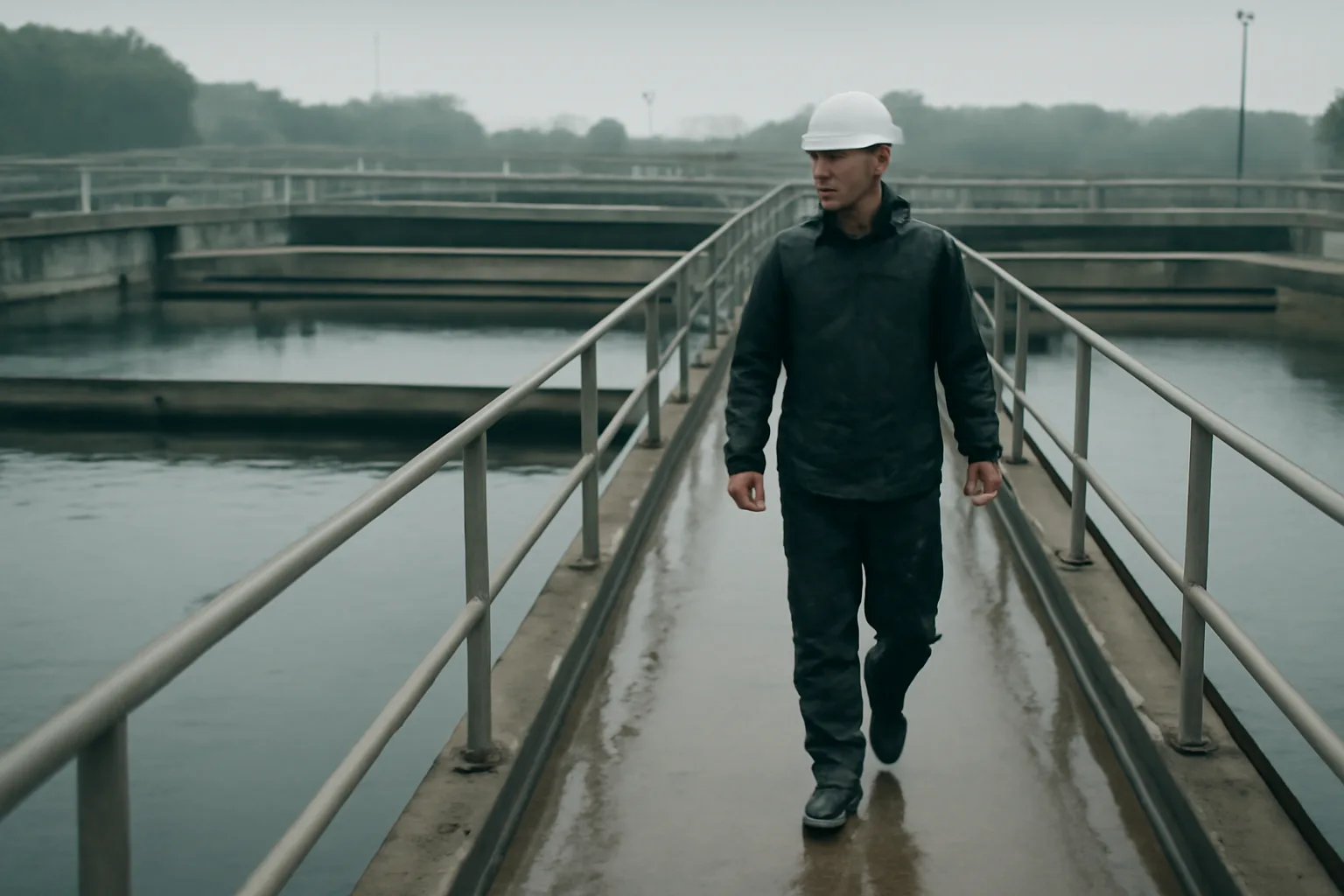
TL;DR
A water treatment operator holds a state card to run a drinking water plant under 40 CFR Part 141 and state rules. You start with a high school diploma in most states, a trainee job, documented experience, then the board exam. There is no national license. Confirm hours, fees, and class names with your state board before you pay.
What is a water treatment operator?
A water treatment operator is the certified person who runs the pumps, chemicals, filters, and monitors so a public water system sends out water that meets federal and state drinking water rules. You are the name on the round sheet. You are also the person the state expects to be in responsible charge when turbidity jumps or a chlorinator fails at 2 a.m.
Federal rules do not print you a national card. They push the states to do it. 40 CFR 141.70 says, "The public water system must be operated by qualified personnel who meet the requirements specified by the State." [2] That one sentence is why your certificate comes from a state drinking water operator board, not from EPA.
Day to day you might jar test, pace a coagulant pump, backwash a filter, read a chlorine residual, log a SCADA alarm, and walk a clearwell. Small systems still do a lot of this by hand. Large plants split it across shifts. The legal idea does not change with plant size. Someone holding the right class of certificate is accountable for process control.
People mix this job with wastewater. Different plant. Different permit. Often a different exam and a different unit of the same agency. If you want that contrast without the marketing fog, read water treatment operator vs nearby career.
EPA's 1999 operator certification guidelines apply to community and nontransient noncommunity public water systems. [1] A community system serves the same people year round. A nontransient noncommunity system is the school, factory, or office park on its own well. Transient systems (some campgrounds and rest stops) sit in another bucket. Learn which kind of system you will actually work at. The paper path follows the system type, not the job title on Indeed.
How do you start as a water treatment operator?
You start by getting hired at a public water system, then you collect the training hours and operating experience your state board lists for the lowest certificate, then you sit that board's exam. That is the path. School can help. It does not replace the card.
Most postings still list a high school diploma or GED. BLS says a high school diploma or equivalent is typically required for water and wastewater treatment plant and system operators. [3] Some utilities want college credits or a water technology certificate. I would not pay a private school until I had a trainee seat and a printed copy of my state's experience table. Too many people buy class first and then learn the board wanted documented hours under a certified operator.
Here is the sequence I would actually follow. Read your state operator certification page and print the lowest-grade requirements. Apply for operator-in-training, plant attendant, or laborer jobs at a city, district, or contract-operated plant. On day one, ask who signs your experience verification and how they log hours. Take only courses the board pre-approves. File the exam application when the hours are real, not when you feel ready. Keep PDFs of everything.
There is no federal processing clock. Boards set their own windows. Confirm with the relevant board. Nobody here can promise you a pass date or an approval.
Do you need a state license to operate a plant?
Yes, if you are in responsible charge of a community or nontransient noncommunity public water system that your state classifies as needing a certified operator. That is the default in all 50 states because of Safe Drinking Water Act operator certification policy and EPA's 1999 guidelines. [1] [13]
EPA put money behind it. The 1999 final guidelines say those guidelines "describe the minimum standards for certification and recertification of operators of community and nontransient noncommunity public water systems." [1] A state that does not run a program meeting them can lose 20 percent of its Drinking Water State Revolving Fund capitalization grant. [1] That is why you will not find a U.S. state that skipped operator cards.
License versus certificate is local wording. California says certificate. Texas says license. New York says certification. The paper does the same job. You cannot legally be the operator of record without it at a classified system.
Helpers, laborers, and some lab techs may work uncertified. The moment you make process decisions, or you are named on the operations plan, you need the class the system requires. Ask the superintendent which certificate the plant's classification demands. Get that in an email.
What education and experience do boards actually require?
Boards mix three ingredients. Education. Training contact hours. Operating experience. The recipe is not national, and anyone selling a national shortcut is selling you a myth.
California splits drinking water into Water Treatment (T1 through T5) and Water Distribution (D1 through D5). Texas issues public water system operator licenses in Class D, C, B, and A. [6] Florida uses Class D through A for water treatment plant operators. New York grades operators by system type and complexity. [7] Same job family. Different ladders. Confirm the current table with the board that will print your name.
| Example state | Treatment grade names | Board to confirm |
|---|---|---|
| California | T1 to T5 (D1 to D5 for distribution) | State Water Resources Control Board |
| Texas | Class D, C, B, A | TCEQ |
| Florida | Class D, C, B, A | FDEP |
| New York | Graded by system type | NYSDOH |
Lowest grades often take a high school diploma or GED, a short training course, little or no experience, then an exam. Some states let you test before you have a job. Some will not. Mid grades want months to years at a classified plant. Highest grades want years, often at a higher classification plant, plus another exam.
I have not seen good public data on how many applicants fail for missing experience versus missing the exam. The closest honest advice is to read the experience definition. Operating experience usually means hands-on process control under a certified operator. It does not mean mowing the levee. If your hours are all janitorial, the board can reject them.
Never assume college swaps 1 for 1 with experience. Some boards allow a substitution formula. Confirm it on the current application instructions, not on a forum post from 2014. Related class-name walkthroughs sit in water treatment operator guide 12 and water treatment operator guide 24.
What exam do most new operators take?
Most new operators take a multiple-choice exam owned either by the state or by the Association of Boards of Certification (ABC), which writes standardized exams that participating state programs use. You apply through the state or its testing vendor. You do not apply through EPA.
If your state writes its own items, ABC will not save you. Check the board site first. Many programs still map their outlines to ABC need-to-know criteria. Use that outline only after you confirm your state is an ABC user.
Topics usually track the process train. Source water. Coagulation. Flocculation. Sedimentation. Filtration. Disinfection. Corrosion control. Lab. Safety. Rules. Memorizing 40 CFR Part 141 tables helps more than a motivational video. [2]
Pass scores are set by the board or the exam owner. I will not quote a percentage here because it is not uniform. Confirm the current cut score and calculator policy with the board. Some exams allow a formula sheet. Some do not.
If you already work nights, study the math you will actually see. mg/L to lb/day. Detention time. Filtration rate. CT. That is the stuff that fails people who only read theory.
WaterTreatmentPath publishes independent reference pieces like this one. If you want a bundled study set after you have the board outline, the $149 one-time Water Op Exam + CEU Kit is on /start. Use it or skip it. The board still grades the exam.
How long does the paper path take from hire to card?
Nobody has a clean national median. Time is experience hours plus exam scheduling plus board review. Lowest grades in some states can happen in a few months if you already work at the plant and the board offers frequent tests. Higher grades take years because the experience clock is the bottleneck.
Do not trust a school that quotes a guaranteed career change on a fixed calendar. They do not issue the card. Your superintendent and your board do.
What you can control is boring, and it works. Get the experience form on day one. Take board-listed training only. File complete applications. Incomplete packages sit in a queue while you refresh your email.
Processing time is a board variable. Confirm with the relevant board. This site does not promise approval or a date. Anyone who does is guessing.
What does first-year operations actually look like?
First year is rounds, logs, and not breaking the residual. You will mix chemicals, wash filters, and call the lead operator when a number looks wrong. You should call. Guessing on chlorine is how systems collect MCL problems.
Safety is not a poster. Permit-required confined spaces show up in clearwells, basins, and vaults. OSHA's 29 CFR 1910.146 is the federal confined space rule that many plants write their entry permits against. [11] If your plant still uses chlorine gas, you will also live with respiratory and process safety procedures. Learn isolation before you volunteer for a tank entry.
Paper you will touch in year one includes daily operation logs, residual and turbidity records, monthly operating reports to the state, sample chain of custody, backwash notes, and your own CEU certificates. Start a folder on week one. CDC describes community water treatment as a staged process utilities run to reduce pathogens and chemicals. [12] Your plant's operations manual is more specific than any national pamphlet. Read it.
A waste of money in year one is a stack of random operator books that do not match your state's exam outline. Buy the outline. Buy one math book. Stop.
BLS groups this work under water and wastewater treatment plant and system operators, SOC 51-8031, and updates wage tables every year. [3] [4] Do not memorize last year's median as if it were your offer. Read the current OES row if you need a number for a salary talk, then ask the utility what they actually pay trainees.
How much do licenses, exams, and CEUs cost?
Fees are set by each board and they move. I will not print a current dollar figure that will be wrong next quarter. Confirm with the relevant board's fee page before you write a check.
Expect separate charges for application, exam, certificate issuance, late renewal, and sometimes a testing-center seat. Utilities often reimburse if you pass. Get that sentence in the offer letter, not in a handshake.
CEUs are required to renew in programs that follow EPA's recertification guideline. [1] [13] Hour counts and approved providers are state-specific. A weekend conference can cover a cycle. A random video playlist will not, unless your board listed that provider.
Training that is not on the approved list is a waste of money. Always. For other cost-shaped notes in this series, see water treatment operator guide 36 and water treatment operator guide 48.
Can you move your water operator license to another state?
Sometimes, by reciprocity or endorsement. Never automatically. There is no national wallet card you flash at a new HR desk.
Reciprocity is easier when both states use similar standardized ABC exams, but it is still a state decision. You usually send a verification letter, meet that state's experience class, and pay their fee. Some states still make you test.
Do not quit a job in State A assuming State B will stamp your card on a fixed clock. Confirm with both boards. Get the reciprocity form number.
Distribution certificates and treatment certificates do not always transfer as a pair. Wastewater never rides along for free. If the new plant is a different classification than the one that grew your hours, expect the new board to cap the grade they will issue.
Water treatment vs wastewater: which paper path is which?
Drinking water operators work under the Safe Drinking Water Act and 40 CFR Part 141. [2] [13] Wastewater operators work under the Clean Water Act and NPDES permits. Different statute. Different exam. Often a different unit of the same environmental agency.
A few states issue a combined license. Most do not. If you want both, plan two exam fees and two CEU tracks. That is not a failure of planning. That is how the statutes are written.
Job sites blur the titles. Water operator in a posting might mean wastewater. Read the plant type. If it says NPDES, WWTP, or activated sludge, that is not this card.
More comparison notes live in water treatment operator vs nearby career and water treatment operator guide 60.
What paperwork should you keep from day one?
Keep a personal file the board cannot lose for you. Hire letter and job description. Experience verification forms, signed. Course completion certificates with course numbers. Exam admission notices and score reports. The issued certificate PDF and any pocket card. Renewal receipts. A running CEU spreadsheet with date, provider, hours, and approval code.
Email yourself copies. Boards change vendors. People retire. Your superintendent's desk drawer is not a records system.
Public water system classification letters matter too. EPA's public water system definitions are how states decide which plants even need which class of operator. [13] If you are collecting experience at a very small ground water system, those hours may not count toward a high-grade surface water certificate. Match hours to the class you want. [6] [7]
If a trainer will not put a course number on the certificate, treat that class as entertainment, not as paper.
What mistakes stall a first water treatment operator card?
Waiting to read the board page until after you paid a school. Logging plant hours that were mowing, painting, and riding in the truck. Taking unapproved CEUs. Testing for the wrong grade (distribution versus treatment). Assuming military water experience will auto-convert. Some states have a path. Many still want their form and their exam. Missing the renewal window and having to retest.
The fix is boring. Print the application checklist. Tick it. Submit it once.
For more first-year checklists in this guide series, see water treatment operator guide 72 and water treatment operator guide 66.
WaterTreatmentPath is an independent publisher, not a law firm and not a service company. If you want the study bundle after you have the board outline, it is the $149 Water Op Exam + CEU Kit at /start. Confirm every fee and hour count with your board. No approval or timing guarantees.
Frequently asked questions
What is water treatment operator?
A water treatment operator is the state-certified person who runs a drinking water plant so finished water meets 40 CFR Part 141 and state rules. You handle process control, monitoring, logs, and often chemical feed. The card comes from your state board, not EPA. Wastewater is a different permit and usually a different exam.
How do you start water treatment operator?
Get a trainee or attendant job at a public water system, print your state board's lowest-grade table, log real operating experience, take only approved training, then apply for the exam. A high school diploma is the typical education floor. Confirm hours, fees, and class names with the board that will issue the card. There is no national license.
Is there a national water treatment operator license?
No. EPA sets operator certification guidelines and can withhold 20 percent of a state's DWSRF grant if the state program does not meet them. The certificate itself is state paper. Reciprocity exists in some pairs of states, but you still apply to the new board and you may still have to test.
Do I need a college degree to become a water treatment operator?
Usually no. BLS lists a high school diploma or equivalent as typical entry education. Some utilities and higher grades want college credits or a water technology certificate. College sometimes substitutes for part of the experience clock. Confirm the substitution formula with your board before you pay tuition.
What is an ABC exam for water treatment operators?
ABC (Association of Boards of Certification) writes standardized certification exams that many state programs use. You still apply through your state or its testing vendor. If your state writes its own exam, ABC outlines will not match. Confirm which exam owner your board uses, then study that outline.
How often does a water treatment operator certificate renew?
Renewal cycles and CEU hours are set by each state board under EPA's recertification guideline. Common cycles are one to three years, but that is not a national rule. Confirm the current cycle, CEU total, and approved providers with your board. Unapproved hours often count as zero.
Can one card cover both water and wastewater?
Usually no. Drinking water sits under the Safe Drinking Water Act and 40 CFR Part 141. Wastewater sits under the Clean Water Act and NPDES. A few states issue a combined license. Most do not. Plan two exams and two CEU tracks if you want both plants.
What is an operator in training (OIT)?
An OIT is a plant employee collecting the operating experience a board requires before, or while, they sit the exam. The title and the rules are state-specific. Some boards register OITs. Some just want a signed experience form later. Ask on day one who is allowed to verify your hours.
Does EPA issue my water treatment operator certificate?
No. EPA published the 1999 final operator certification guidelines and oversees whether state programs meet them. Your certificate, exam, fees, and CEU list come from the state drinking water operator board (or the state health or environmental agency that runs that board).
What happens if I fail the water treatment operator exam?
You retake it under the board's retake rules. Wait periods, extra fees, and attempt limits are state-specific. Confirm them before you schedule. Study the math and the process units you missed. Do not buy a new school just because you failed once.
Are online CEUs accepted for water operator renewal?
Only if your board listed that provider and course. Online is not the test. Approval is the test. Keep the certificate with the course number. If a vendor cannot show a board approval code, treat the hours as a waste of money until you confirm.
What does responsible charge mean for a water treatment operator?
It means you are the certified person accountable for process decisions at a classified public water system. Helpers can turn valves under direction. The operator of record is the one the state expects to know why the residual moved. Your plant classification letter tells you which grade that person must hold.
Do very small well systems need a certified water treatment operator?
Many community and nontransient noncommunity systems do, including small ones, because of state programs built on EPA's 1999 guidelines. Transient systems and some very small setups may sit in a different class. Confirm with the primacy agency. Do not guess from the well house size.
Should I pay for exam prep before I am hired?
I would not, except for a cheap look at the official need-to-know outline. The bottleneck is usually documented experience under a certified operator, not a practice test. Get the trainee seat, print the board checklist, then buy prep that matches that outline. Unapproved schools do not issue cards.
Sources
- U.S. EPA, Final Guidelines for the Certification and Recertification of the Operators of Community and Nontransient Noncommunity Public Water Systems (Federal Register): EPA's 1999 final guidelines set minimum standards for state operator certification and recertification and authorized 20 percent DWSRF withholding for noncompliant state programs.
- eCFR, 40 CFR 141.70 General requirements: A public water system must be operated by qualified personnel who meet the requirements specified by the State.
- U.S. BLS, Occupational Outlook Handbook: Water and Wastewater Treatment Plant and System Operators: Typical entry education is a high school diploma or equivalent, and states require operators to be licensed or certified.
- U.S. BLS, Occupational Employment and Wage Statistics, SOC 51-8031: BLS classifies water and wastewater treatment plant and system operators under SOC 51-8031 and publishes annual wage estimates for the occupation.
- Texas Commission on Environmental Quality, Water Operator Licensing: TCEQ issues public water system operator licenses in Class D, C, B, and A.
- New York State Department of Health, Drinking Water Operator Certification: NYSDOH runs drinking water operator certification graded by system type and complexity.
- OSHA, 29 CFR 1910.146 Permit-required confined spaces: Federal permit-required confined space rules apply to many clearwell, basin, and vault entries at treatment plants.
- CDC, Water Treatment: CDC describes community drinking water treatment as a staged process used to reduce pathogens and chemicals.
- U.S. EPA, Information about Public Water Systems: EPA defines community, nontransient noncommunity, and transient noncommunity public water systems that state operator rules attach to.