Last updated 2026-08-21
TL;DR
A water treatment operator runs a drinking water plant under a state certificate so finished water meets federal and state rules. You start with a high school diploma, then complete your board's mix of experience, approved training, and an exam. Class names differ by state. There is no national license. Confirm fees and dates with the board that issues the paper.
What is a water treatment operator?
A water treatment operator is a state-certified person who runs a drinking water plant so finished water meets federal and state standards. You control treatment processes, watch quality data, and keep the records a primacy agency can pull in an inspection. BLS places this work in occupation 51-8031 with wastewater operators.[1]
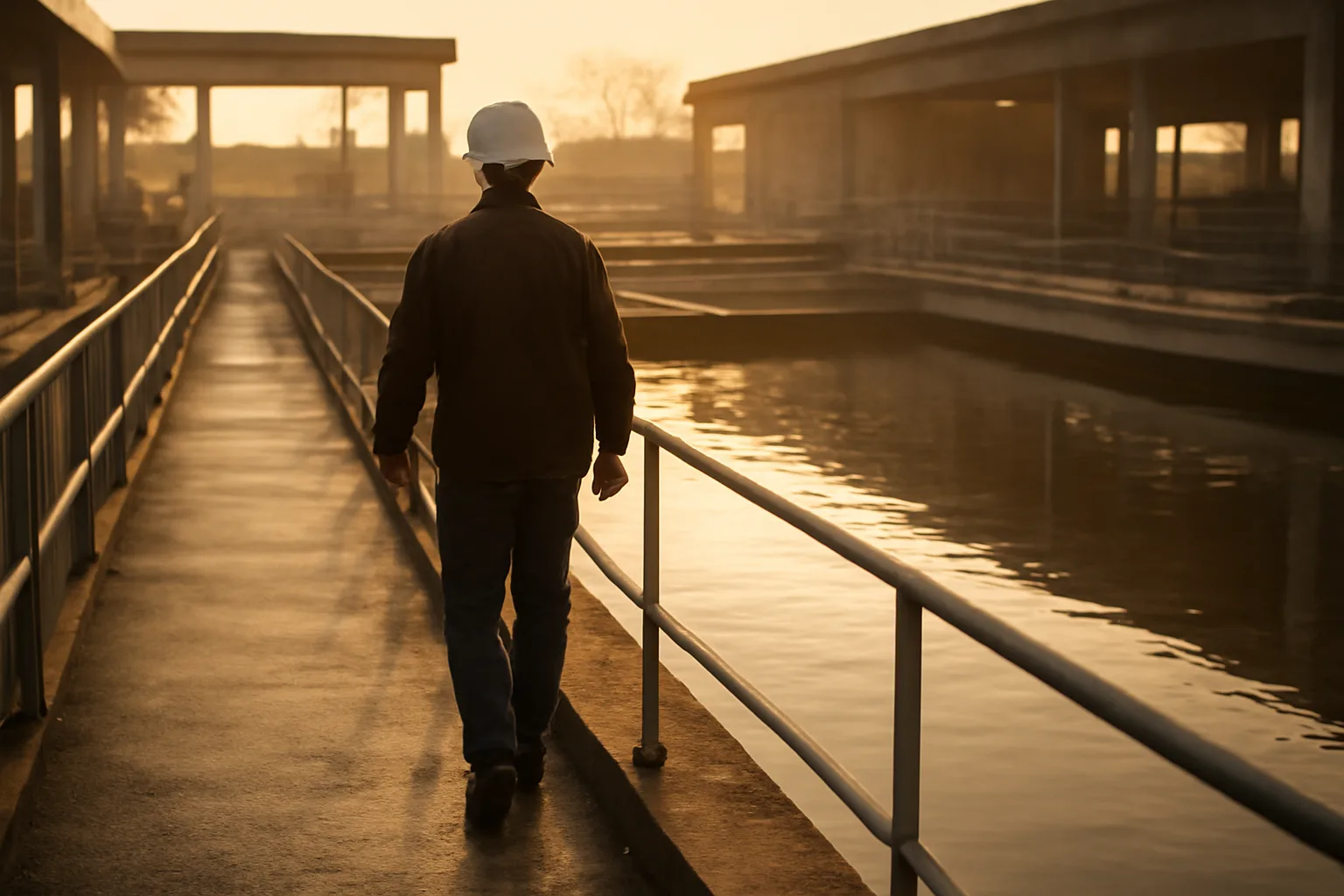
The work is physical and procedural. You walk basins. You change chlorine cylinders or switch hypochlorite pumps. You pull grab samples. You write what happened on the shift, including the ugly parts.
Federal law is why plants cannot skip this role. 42 U.S.C. 300g-8 states, "The Administrator shall by regulation specify minimum standards for certification (and recertification) of the operators of community and nontransient noncommunity public water systems."[3]
EPA published those minimum standards in 1999. The Federal Register notice (64 FR 5916) tells states how operator certification programs have to work if they want to keep drinking water primacy.[4] 40 CFR 142.10 ties a state's primacy package to having an operator certification program that meets those guidelines. If you work at a community or nontransient noncommunity system, someone with the right certificate is supposed to be in charge of operations.[6]
Surface water plants live under the treatment technique rules in 40 CFR Part 141, Subpart H. 40 CFR 141.70 requires filtration and disinfection for public water systems using surface water, with the exceptions the rule itself lists. That is the legal backbone for the turbidity and disinfection work you will do on those plants.[5]
People mix this job up with distribution operators, wastewater operators, and lab analysts. Distribution is pipes, tanks, and residuals after the plant. Wastewater is the other direction. Lab work supports you, but the operator still owns process decisions and the monthly operating report.
Here is how I would describe the job to a friend. You are paid to keep a public health machine inside its box, then prove it on paper. The title on your certificate will say treatment, water treatment plant operator, or a grade code your board invented. The work is still process control plus records.
How do you start as a water treatment operator?
You start by picking one state, reading that board's operator certification rules, and lining up a high school diploma (or GED), qualifying experience or approved training, and the exam for the lowest grade that board offers. BLS says operators typically need a high school diploma or equivalent and a license to work.[1]
There is no federal license you can hang on the wall and take to any plant. EPA sets the floor. Your state (or a tribe, or EPA if the state does not have primacy) issues the certificate.
Here is the sequence I would actually follow. First, decide where you will work. Plants hire locally. Reciprocity exists in some pairs of states and is a mess in others. Start where you can get signed hours.
Second, open the board's operator page and download the current application, experience form, and exam schedule. For California that is the State Water Resources Control Board drinking water operator certification program, with treatment grades T1 through T5.[7] For Texas it is TCEQ water operator licensing, with Class D through Class A treatment licenses.[8] For Florida it is the Department of Environmental Protection operator certification program, with Class D through Class A water treatment plant operators.[9]
Third, get trainee or operator-in-training status if your state uses one. Some boards let you sit a very low grade exam with little experience if you complete an approved course. Others want months of documented hours first. Confirm with the board. Do not trust a forum post from 2017.
Fourth, log hours on the form the board wants, not a homemade spreadsheet. Supervisors sign. Dates matter. If the form asks for process type (surface, groundwater, membrane), fill it the way the plant is classified, not the way your buddy talks.
Fifth, sit the exam. Many states use Association of Boards of Certification (now Water Professionals International) standardized exams. The license is still the state's. Passing an ABC-style exam does not, by itself, let you operate in a state that never issued you paper.[13]
Sixth, post the certificate where the plant requires it, then calendar the renewal. Renewal is a different paper path. If California is your board, read water treatment operator renewal in California. If you are under TCEQ, use Water treatment operator renewal in Texas: the complete guide.
I would not quit a decent job until a plant has a path for you to get signed hours. The bottleneck is almost always experience, not the textbook.
Is there a national water treatment operator license?
No. A water treatment operator certificate is a state credential. EPA tells states the minimum their programs must include. The agency does not mail you a national operator card you can carry from Maine to Hawaii.
The 1999 EPA operator certification guidelines apply to community and nontransient noncommunity public water systems. States with primacy build their own grades, experience tables, exam vendors, and renewal rules on top of that floor.[4][12]
ABC (WPI) standardized exams are a testing product. Lots of boards buy that product so they do not write every item bank from scratch. A passing score still has to be accepted by your board, tied to an application, and printed as a state certificate.[13]
I would ignore any school or website that sells a "national water treatment operator license" as if it replaced the board. If a plant's insurance and the primacy agency cannot find you in the state database, you are not the operator of record.
Military training, college credits, and out-of-state certificates sometimes count as education or experience. They still go through the receiving board's reciprocity or equivalency process. Confirm that process. Nobody here can promise another state will take your hours.
What education and experience do boards require?
Most boards start at a high school diploma or GED. That matches BLS, which lists a high school diploma or equivalent as typical entry education for occupation 51-8031.[1] A college degree can shorten the experience clock in some states. It is not a federal requirement.
Experience is the part people underestimate. Boards want documented time on processes that match the grade you want. Running a mower at the plant rarely counts. Pumping residuals, feeding coagulant, and writing the shift log usually does. The affidavit has to come from a supervisor the board will recognize.
Approved courses can substitute for part of the experience in some programs. California, Texas, and Florida all publish course or training rules on their operator certification pages. The course number and provider matter. A random YouTube playlist does not.[7][8][9]
I would read the experience table before I paid for a class. If your state wants 1 year of actual plant time for the first real charge grade, a weekend seminar will not erase that. If your state lets a named 20-hour or 60-hour course open the lowest exam, take that named course and skip the rest.
Age, legal presence, and sometimes a background check sit on the application too. Those rules are board-specific. Confirm them on the current form, not in this article.
What does the water treatment operator exam cover?
The exam covers the Need-to-Know topics for the grade you sit: source water, coagulation, filtration, disinfection, corrosion control, labs, safety, and rules. ABC-style outlines break tasks by job analysis, not by your plant's brand of filter.[13]
Expect math. Dosage, detention time, filtration rate, pump calculations, and unit conversions show up at every level I have seen. If you cannot move between mg/L, gpm, and MGD without a panic, drill that first. Formula sheets, if your board allows them, are still a trap if you do not know which formula you need.
Expect rules in plain clothes. Residual, CT, turbidity, and sample invalidation are not trivia. They are how 40 CFR Part 141 shows up as a multiple-choice item.[5]
Safety items are not filler. Chlorine exposure and permit-required confined spaces are real OSHA topics you will see in plants and on tests. OSHA's chlorine page and 29 CFR 1910.146 are the primary texts, not a vendor pamphlet.[10][11]
I would study from the board's reference list, then grind old-style questions until the math is boring. Do not memorize one plant's SCADA screens. The exam does not care about your HMI colors.
How much does water treatment operator certification cost?
Fees are set by each board and they change. I will not invent an exam fee, certificate fee, or processing time. Confirm the current amount on the board's fee or application page before you write a check.[7][8][9]
Budget for more than the exam. You may pay for an approved course, a photo, a late filing, a retake, and later a renewal. Plants sometimes reimburse. Get that in writing.
Study materials are a separate pile. The board-recommended manual is usually worth buying. A hotel bootcamp can be a waste if your state already requires a specific approved course you must take anyway. Question banks help if they match your exam vendor. They do not replace the approved course when the course is mandatory.
If you want one paid study bundle after you have the board's own list, WaterTreatmentPath sells a $149 one-time Water Op Exam + CEU Kit. No board requires that kit. Plenty of operators pass with the state manuals and a cheap calculator.
I would not buy CEUs before you hold a certificate. Most boards will not bank random hours for a person they have not licensed yet. Confirm that too.
What does first-year operations work look like?
First-year work is rounds, chemicals, samples, and paper. You learn the plant's normal, then you learn what "not normal" smells like. Nobody hands you a cinematic control room on day one.
On a surface plant you will watch coagulant dose, floc, settling, filter head loss, and combined filter effluent turbidity. You will backwash. You will worry about a filter that just will not come clean. On a groundwater plant you may live in the chlorinator room and the well vault instead.
Sampling is not optional theater. Coliform samples have a siting plan and a hold time. If you miss the sampler window, you own that. Chain of custody is part of the job, even when the lab is across the parking lot.
Chemicals will take more respect than the exam implied. Chlorine gas, hypochlorite, acids, polymers, and fluoride (where used) all have feed, spill, and PPE rules. OSHA's chlorine guidance is a starting point, not a plant SOP. Read your SOP anyway.[11]
Confined spaces show up as wet wells, tanks, and vaults. 29 CFR 1910.146 is the federal confined space rule. If your plant treats entry casually, that is a problem, not a culture you should copy.[10]
Shifts include nights, weekends, and holidays because water does not pause. On-call is common at small systems. I would ask about call-out pay before I accepted the job, not after the third 2 a.m. high-service trip.
The unglamorous skill is the log. If it is not written, the inspector will assume it did not happen. Write the dose change. Write the alarm you silenced and why.
How much do water treatment operators make?
BLS reported a median annual wage of $54,890 for water and wastewater treatment plant and system operators in May 2023.[1] That figure mixes water and wastewater, small towns and big cities, and every shift pattern. Your offer will not match the median on purpose.
BLS counted about 120,700 jobs in that occupation in 2023, with projected growth of 6 percent from 2023 to 2033 (about 7,000 more jobs). That is "as fast as average" in BLS language, not a hiring frenzy.[1] Local retirements still open seats. Rural plants still struggle to fill nights.
Pay bands move with overtime, certification grade, and whether you also hold distribution. A Class D or T1 trainee rate can look grim until you clear the first charge grade. I would negotiate the grade bump in writing when I was hired, not as a vibe.
Nobody has a clean, current, national table of water-only wages split from wastewater that I trust more than BLS. The closest public source is still occupation 51-8031. Check the live BLS table before you use the median in a salary argument.[2]
Which state board issues your certificate?
The board that issues your certificate is the drinking water operator certification program in the state where the plant sits. That is usually an environmental quality department, a health department, or a water board, not EPA Region letterhead.
California uses the State Water Resources Control Board for drinking water operator certification (treatment T1 through T5, plus separate distribution grades).[7] Texas uses TCEQ occupational licensing for water operators.[8] Florida uses DEP's water and domestic wastewater operator certification program.[9]
Other states split the work differently. Some put drinking water under health and wastewater under environment. Read the page that says "drinking water operator," not the page that says "wastewater," unless you actually want that license.
Renewal rules are local too. If you already hold paper and need the next cycle, use a state guide rather than guessing CEU hours. Start with Arizona water treatment operator renewal: fees, CEUs, and timeline, Alabama water treatment operator renewal: what ADEM requires, water treatment operator renewal in Florida, water treatment operator renewal in colorado, or CT water treatment operator renewal: CEUs, fees, and requirements.
If two web pages disagree, the current regulation and the signed application instructions win. Call the board. Keep a note with the date and the person's unit, not their personal cell.
What paper should you keep in year one?
Keep copies of everything that proves you may operate, and everything you signed that proves the plant ran legally. Boards and inspectors do not share your email search anxiety.
Start a folder (paper or a backup you control) with your application, experience affidavits, course completion, exam result, and the certificate image. Add renewal receipts later. If a supervisor leaves, those signatures get harder to replace.
On the plant side, keep shift logs, chemical delivery tickets, calibration records, and the monthly operating report you helped complete. If you collect compliance samples, keep the chain of custody. EPA's materials for current operators exist because systems fail on records as often as they fail on a pump.[12]
I would photograph the posted certificate and the current SOP index on day one. Plants reshuffle binders. Your name on last year's MOR still matters if a violation gets reconstructed.
Do not store the only copy on a plant computer you lose access to when you change shifts. That sounds petty until it happens.
What training is worth paying for?
Pay first for whatever your board named as an approved course for the grade you want. That course is the one that actually moves the application. Everything else is optional.
Pay next for the reference the exam vendor or board lists. If they name a manual, buy that edition, not a 12-year-old photocopy with someone else's highlighter theology.
Skip most of the rest until you fail once or your plant requires a site-specific class (chlorine, confined space, respiratory). OSHA topics are real, but a generic eight-hour "water safety" certificate from an unknown vendor is often duplicate of what the utility already has to give you.[10][11]
I would not buy out-of-state CEU bundles on day one. Hours that do not match your board's approval list are a donation. After you are certified, follow that board's renewal list. Georgia operators should use water treatment operator renewal in georgia rather than a national CEU shopping cart.
Pass rates published by vendors are marketing. I have not seen a single national, board-verified pass-rate dataset I would plan a life around. Study until the math is easy. Then sit.
How do you move up after your first certificate?
You move up by collecting the next grade's experience, then sitting the next exam. Boards stack grades so a higher certificate matches more complex processes or larger systems. California T1 through T5 and Texas or Florida Class D through A are the same idea with different letters.[7][8][9]
Do not sit the next exam for sport if your plant cannot use the grade. Some boards limit how far you can jump without time in grade. Confirm the ladder.
Distribution is a parallel ladder, not a promotion. If your utility needs both, get both. If you only work inside the fence, treatment hours may not count as distribution hours. Read the definitions.
Supervisory titles at the utility (lead, chief, superintendent) are employment. They are not a substitute for the certificate class the plant classification requires. You can be "in charge" on the org chart and still be out of compliance if the paper is wrong.
I would calendar the next experience date the week I passed, then ignore upgrade talk until those hours were real.
Where should you confirm facts before you apply?
Confirm class names, fees, exam dates, approved courses, and processing steps with the board that will print the certificate. This site is a map. It is not your application.
Use the statute and the Code of Federal Regulations for the federal floor (42 U.S.C. 300g-8, 40 CFR 141.70, 40 CFR 142.10).[3][5][6] Use BLS for wage and education snapshots, then check the live table because occupational numbers move.[1][2] Use your state operator page for the paper you will actually file.[7][8][9]
WaterTreatmentPath is an independent publisher, not a law firm and not a service company. Nothing here is an approval, a quota, or a timing guarantee. If you still want the optional kit after you have the board's own list, use /start.
If a study guide and a board PDF fight, the board PDF wins. Every time.
Frequently asked questions
What is a water treatment operator?
A water treatment operator is a state-certified plant operator who runs processes that produce drinking water meeting federal and state standards. You control treatment, watch quality data, and keep inspection records. BLS groups the job with wastewater under occupation 51-8031. The certificate class must match the plant. Confirm titles with your board.
How do you start as a water treatment operator?
Pick the state where you will work, then follow that board's path: high school diploma or GED, documented experience or an approved course, and the exam for the lowest grade. There is no national license. Get trainee status if the board offers it, log hours on the official affidavit, then apply. Confirm fees and dates with the board.
Do you need a college degree to be a water treatment operator?
No. BLS lists a high school diploma or equivalent as typical entry education, plus a license. Some boards let college credits reduce the experience clock. A degree can help hiring. It does not replace the state exam or the signed hours. Confirm substitution rules on your board's current application, because they differ.
Can you operate a plant without a state certificate?
Not as the operator in charge of a community or nontransient noncommunity system that falls under EPA's operator certification guidelines. 42 U.S.C. 300g-8 and 40 CFR 142.10 put certified operators inside state primacy. Helpers and trainees work under rules the board defines. Confirm what uncertified staff may do before you take a shift alone.
How long does it take to get certified?
It depends on the board's experience table and exam calendar. Some lowest grades open after an approved course. Charge grades often need months to years of signed plant time. Nobody here can promise a processing time. Read the current experience chart and exam schedule, then ask the board how it dates an application as complete.
What is the difference between water treatment and wastewater operators?
Water treatment operators produce drinking water under the Safe Drinking Water Act and 40 CFR Part 141. Wastewater operators treat used water under a different permit world. BLS lumps the occupations for wage statistics, but boards issue separate certificates. Hours rarely transfer automatically. If you want both, plan two paper paths.
Do operator certificates transfer between states?
Sometimes, through reciprocity or equivalency, not by default. The receiving board decides whether your grade, exam vendor, and hours count. You may sit another exam or take a rules course. Do not start work in a new state on the old certificate alone. Ask that board in writing and keep the reply.
What is an ABC or WPI exam?
ABC, now Water Professionals International, writes standardized operator exams many states buy. Passing that exam is not a 50-state license. Your state still has to accept the score, take your application, and issue paper. Study the Need-to-Know for the grade you will sit, then confirm the vendor your board actually uses.
Do water treatment operators work nights and weekends?
Often yes. Plants run continuously, so shifts include nights, weekends, and holidays. Small systems add on-call. Ask about coverage, call-out pay, and whether a certified operator must be on site or only available. The certificate class still has to match the plant even at 3 a.m.
Is chlorine handling part of the job?
At most plants, yes. You may feed gas chlorine, hypochlorite, or both, and you will measure disinfectant residual for compliance. OSHA publishes chlorine safety information, and confined space rules can apply to chlorinator rooms and tanks. Your plant SOP and the state certificate still govern what you are allowed to do.
What CEUs do you need after you pass?
Whatever your issuing board lists for renewal, in the units and topics it accepts, inside the cycle it sets. Hours from a random vendor may not count. Do not buy CEUs before you are certified unless the board says it will bank them. Use that state's renewal page and confirm before you pay.
Can you start as a laborer and then sit the exam?
Yes, if the laborer hours include the process work the board counts and a supervisor will sign the affidavit. Mowing and painting usually do not count. Feeding chemicals, running filters, and writing logs usually do. Get the official experience form on day one so you are not reconstructing a year from memory.
Does military water treatment experience count?
It can count as education or experience if the receiving board accepts it. You still apply to that board, and you may still sit its exam. Bring training records and duty descriptions that name processes, more than a job title. Confirm equivalency in writing. Do not assume a military MOS replaces a state certificate.
Who should you call if a study guide conflicts with a board PDF?
Call the operator certification unit listed on the board's program page. The current application instructions and regulations win over any guide, including this one. Note the date, the topic, and the unit you reached. WaterTreatmentPath is an independent publisher, not a law firm and not a service company.
Sources
- U.S. BLS Occupational Outlook Handbook, Water and Wastewater Treatment Plant and System Operators: Median annual wage $54,890 (May 2023); about 120,700 jobs in 2023; 6% projected growth 2023-33; typical entry education is a high school diploma or equivalent plus a license
- U.S. BLS OEWS, SOC 51-8031, May 2023: Occupational Employment and Wage Statistics wage table for water and wastewater treatment plant and system operators, May 2023
- Cornell LII, 42 U.S.C. § 300g-8 Operator certification: EPA shall specify minimum standards for certification and recertification of operators of community and nontransient noncommunity public water systems
- Federal Register, EPA Final Guidelines for Operator Certification (64 FR 5916): 1999 EPA final guidelines set minimum standards for state operator certification programs for community and NTNC public water systems
- eCFR, 40 CFR 141.70 General requirements: Filtration and disinfection requirements for public water systems using surface water (Subpart H)
- eCFR, 40 CFR 142.10 Requirements for a determination of primary enforcement responsibility: State drinking water primacy includes an operator certification program meeting EPA guidelines
- California State Water Resources Control Board, Drinking Water Operator Certification Program: California certifies drinking water treatment operators in grades T1 through T5, with separate distribution grades
- Texas Commission on Environmental Quality, Water Operator Licensing: TCEQ issues Texas water operator licenses, including treatment classes D through A
- Florida DEP, Water and Domestic Wastewater Operator Certification: Florida DEP certifies water treatment plant operators in Class D through Class A
- OSHA, 29 CFR 1910.146 Permit-required confined spaces: Federal permit-required confined space standard that applies to many plant tanks, vaults, and wet wells