Last updated 2026-08-21
TL;DR
A water treatment operator runs plant processes so drinking water meets federal and state rules. You start with a high school diploma or GED, then you meet your state board's hour rules, pass that board's exam, and renew with CEUs. There is no national license. BLS put median pay at $54,890 in May 2023. Confirm fees with the board that covers your plant.
What is a water treatment operator?
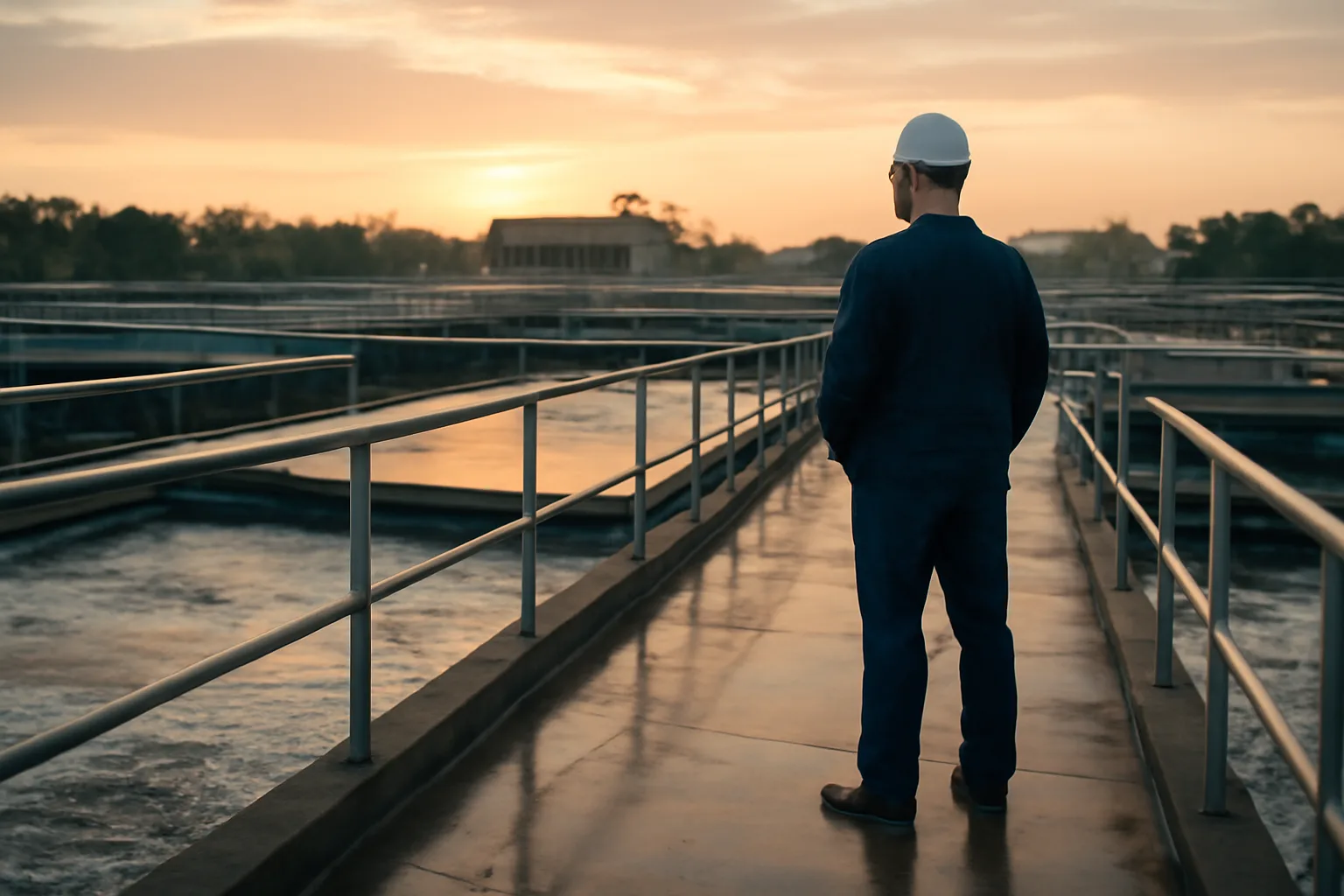
A water treatment operator is the certified person who runs drinking water treatment processes so finished water meets the Safe Drinking Water Act and the state's drinking water rules. You watch pumps, chemical feeds, filters, and lab readings, then you change the plant when those readings drift.
That is the job. You are not designing the plant. You are keeping it inside its window on your shift.
BLS files this work under water and wastewater treatment plant and system operators. "Water and wastewater treatment plant and system operators typically need a high school diploma or equivalent and a license to work." [1] The same occupational group had a $54,890 median annual wage in May 2023. [2]
EPA counts more than 148,000 public water systems in the United States. [3] A lot of those plants are small. You might be the only person on site at 2 a.m. with a turbidimeter, a phone, and a logbook.
Day to day you dose coagulant, watch floc form, backwash filters, check disinfectant residual, and write the result even when it is ugly. O*NET lists tasks like adding chemicals, inspecting equipment, and recording operational data for this occupation. [12] The paper trail is part of the work. Inspectors read what you wrote.
Treat this as a trade with a state card, not a vague water career. If you cannot name the board that will print your certificate, you do not have a path yet. Plants also have to hit EPA's National Primary Drinking Water Regulations, which are the legally enforceable limits behind those log sheets. [13]
How do you start as a water treatment operator?
You start by picking the state board that covers the plant where you will work, then you match that board's lowest operator class. Get a high school diploma or GED, apply as an operator-in-training if the state uses that status, log the hours the class requires, and sit the exam for that class.
There is no federal operator card you can hang on the wall. 42 U.S.C. 300g-8 tells EPA to issue guidelines for state programs. The statute says EPA shall issue guidelines "specifying minimum standards for certification (and recertification) of the operators of community and nontransient noncommunity public water systems." [6]
EPA published those final guidelines in 1999. [4][5] States then built their own grades, fees, and hour tables on top. Your path is that table, not a national myth.
Here is the order I would use. Call the chief operator at a plant that will hire a trainee. Read that state's operator rules, not a blog summary. Get on the clock so your hours count. File the exam application the way the board prints it. Sit the lowest class that lets you be useful on that site.
Skip national certificates sold on the internet. They do not replace a state grade. California's drinking water operator certification program is a clear example of a state-run path with its own grades and exams. [10] Florida writes operator licensing into statute, including who may sit for licensure. [7] Texas runs water operator licenses through TCEQ, not through EPA. [14]
People stall here because they study for the wrong class. Match the plant classification first. Then study.
Is there a national water treatment operator license?
No. You do not get a single U.S. water treatment operator license. Certification is a state program that has to meet EPA's 1999 guidelines, or the state risks a penalty against Drinking Water State Revolving Fund money. [4][5] EPA still describes operator certification as a state-implemented program under the Safe Drinking Water Act. [11]
Some states accept another state's certificate through reciprocity or endorsement. That is a second application, not an automatic stamp. TCEQ issues Texas water operator licenses under Texas rules. [14] California issues its own grades. [10] Those packets do not copy each other.
ABC (now under Water Professionals International) writes standardized exams that many boards buy. Passing an ABC exam still lands you a state certificate, not an ABC license you can take everywhere.
If a vendor says they will license you nationally, walk away. That claim falls apart at a state drinking water desk. Buy training that maps to your board's outline. Ignore the rest.
What education and experience do state boards want?
Most boards start with a high school diploma or GED. College can substitute for some experience, but the substitution table is a state rule, not a courtesy. Florida statute 403.872 sets licensure requirements and routes applicants through a department exam. [7] California publishes grade-specific paths on its drinking water operator certification program page. [10]
Experience usually has to be at a plant of a certain class, under a certified operator. Pushing a broom in the shop may not count. Reading meters on the distribution side may not count toward a treatment grade. Ask the board, in writing, before you bet a year of nights on it.
| Piece | Typical board rule | What I'd confirm |
|---|---|---|
| Diploma or GED | Required for almost every first grade | Whether a transcript must be official |
| Operator-in-training | Some states issue OIT or trainee status | Whether OIT hours count at 1:1 |
| Experience | Months or years tied to plant class | Treatment versus distribution credit |
| Education swap | College credits knock down hours | The exact credit-to-month table |
| Exam | Class or grade you applied for | ABC, state-written, or closed book |
I would not enroll in a two-year environmental degree just to sit a first grade. If the board gives a one-year hour reduction for 30 credits, do the math. Plenty of solid operators never sat in a college lab.
Military water treatment jobs sometimes count. Bring the Joint Services Transcript and let the board say yes or no. Do not assume an MOS code is enough without their letter.
What does the water treatment operator exam cover?
The exam matches the grade. Lower grades lean on math, safety, disinfection, and how a filter actually works. Higher grades add process control, rules, and plant administration.
You will see gallons per minute, detention time, chemical feed rates, chlorine demand, and filter loading. Units will try to trip you. Drill unit conversions until they are boring.
Need-to-know lists, when your board posts them, beat random video playlists. If your state uses an ABC standardized exam, get that outline. If California or another self-written state is your board, use that board's exam references. [10] TCEQ posts Texas licensing steps on its water operator page. [14]
Passing scores are set by the board. I will not quote a national cut score because boards do not share one. I do not have a trustworthy national pass-rate file either. Boards publish that data unevenly, and some do not publish it at all.
Do not buy five exam apps. One honest question bank plus the board outline is enough. WaterTreatmentPath publishes a $149 one-time Water Op Exam + CEU Kit if you want practice items and CEU tracking in one purchase. Skip it if your utility already pays for a better course.
Closed book versus open book is a state choice. So is calculator policy. Read the admission letter. Then follow it.
How much does water treatment operator certification cost?
Costs are a stack of board fees, exam vendor fees, training, and the wages you lose sitting a class. They are not one national price. Confirm the live fee with the board that will print the card.
Florida even puts certificate renewal in statute. [8] California posts program rules on its operator certification page. [10] TCEQ publishes Texas water operator licensing steps. [14] None of those pages is a U.S. fee schedule.
For a feel of how the stack differs by state, read water treatment operator cost in California, water treatment operator cost in Florida, How much water treatment operator cost in Colorado adds up to, and Water Treatment Operator Cost in Alaska: Fees, Timeline, and License Steps.
I would not pay an expediter to fill a two-page form. I would not buy framed dummy certificates. Training the board will not accept for hours or CEUs is a donation, not a path.
Exam retake fees add up if you sit unprepared. That is the cost people forget. Study the outline you will actually see.
What does first-year work look like on a plant?
First-year work is shift work, sampling, and learning which alarm is real. You will handle coagulants, polymers, disinfectant, and fluoride if the plant fluoridates. OSHA's Hazard Communication Standard covers labels, safety data sheets, and training for hazardous chemicals in the workplace. [9] Read the SDS before you change a drum.
You will collect turbidity, pH, disinfectant residual, and maybe coliform samples. You will write the result even when it is ugly. Hiding a bad reading is how people lose certificates.
Nights and weekends are normal. Plants do not pause for holidays. If you cannot do rotating shifts, this trade will make you miserable.
The useful first-year skill is noticing when the plant is lying. A sudden filter headloss jump. A clearwell residual that will not hold. A raw-water turbidity spike after a storm. You call the certified operator in charge before you invent a fix.
Keep a personal notebook of feed rates that worked for each raw-water condition. That notebook is not official. The official log is. Keep them separate so you never mix scratch math with the legal record.
How much do water treatment operators get paid?
BLS reported a $54,890 median annual wage for water and wastewater treatment plant and system operators in May 2023. [2] That figure mixes water and wastewater, small towns and big cities, first grade and top grade. Nobody has a clean national drinking-water-only wage table. The closest public series is that combined BLS occupation. [1][2]
Rural plants often pay less and give you more responsibility. Union city plants often pay more and keep you in a narrower lane. Overtime on nights and weekends is where a lot of operators make the job livable.
The BLS number is a national median, not an offer letter. Ask the utility for the step chart. Ask whether on-call is paid. Ask whether you are non-exempt.
The Occupational Outlook Handbook page for this occupation is also where BLS publishes typical entry education and the current job outlook. [1] Openings still show up when people retire. Treat it as a stable municipal trade, not a boom job.
How do CEUs and certificate renewals work?
After you pass, the clock starts. Boards require continuing education and a renewal fee on a cycle that is often two or three years. Florida statute 403.867 addresses annual renewal of operator certificates. [8] Other states differ. Confirm the cycle with your board. Do not copy Florida's calendar onto another state.
CEUs have to be on the board's accepted list. A random webinar may not count. Keep the completion PDF with the provider name, hours, and date.
Spread CEUs across the cycle. Cramming a pile of hours in the last week is how people miss renewal and cannot sign the monthly report.
Some boards let extra education substitute on an upgrade application. That is separate from renewal CEUs. Do not mix the two piles of paper.
If you let a certificate lapse, reinstatement can mean a new exam. That is a miserable way to spend March. Put the expiration date on a calendar the week you pass.
Is a wastewater license the same thing?
No. A wastewater license is not the same thing. Treatment of sewage is a different rule stack, a different exam, and often a different desk. Some states put both under one operator program with separate licenses. Some split drinking water and wastewater across agencies.
A water treatment operator works on the drinking water side, surface water or groundwater treatment. Distribution operator work is another grade in many states. Do not assume a treatment certificate lets you run the collection system or the sewer plant.
EPA's operator certification guidelines that implement SDWA 1419 apply to community and nontransient noncommunity public water systems, not to wastewater plants. [4][6] The Safe Drinking Water Act overview page is about drinking water, not sewage. [11]
If you want both cards, plan two exam paths. Get the one your current plant needs first. Split study is how people fail both.
What paperwork should you keep from day one?
Keep a folder (paper or scanned) with your diploma or GED, experience letters on utility letterhead with dates, plant class, and duties, exam admission letters and score reports, the certificate PDF, CEU completions, and any OIT card.
When you change states, that folder is the reciprocity packet. When a new HR person doubts your hours, that folder is the argument.
Keep copies of the monthly operating reports you signed, if policy allows. They prove you were the operator of record, not a visitor.
Email the board when a rule is unclear and save the reply. Verbal advice from a trainer is not a variance.
California, Texas, and Florida all want applications that match their forms, not a resume. [10][14][7] A pretty CV does not log treatment hours. The letter from the utility does.
What mistakes stall a first water treatment operator certificate?
The usual stall is studying the wrong grade. Logging hours at a site the board will not call treatment experience is a close second.
Paying for a national operator license is a waste of money. Paying a consultant to type your name on a state form is a waste of money.
Sit the exam your plant will actually use. Get the experience letter the month you leave a job, not three years later when the superintendent has retired.
Reciprocity is not guaranteed when you move. Read How Much a Water Treatment Operator License Costs in Arkansas, water treatment operator cost in Arizona, Water treatment operator certification cost in Connecticut (2026), and water treatment operator cost in Georgia before you assume the new state is a photocopy of the old one.
If you want the kit we publish, go to /start after the board application is in motion. Do not reverse that order. Confirm every fee, date, and hour rule with the issuing agency. No article can promise approval.
Frequently asked questions
What is a water treatment operator?
A water treatment operator is the state-certified person who runs drinking water treatment processes so finished water meets SDWA and state rules. You monitor equipment and water quality, adjust chemical feeds and filters, and keep the legal logs. BLS groups the work with wastewater plant operators and listed a $54,890 median wage in May 2023.
How do you start as a water treatment operator?
Start with the board that covers your plant, not a national vendor. Get a diploma or GED, hire on as a trainee if you can, log the hours that class requires, then sit that board's exam. EPA's 1999 guidelines set a federal floor. Each state writes the grade table, fees, and CEUs. Confirm those details with the board before you pay for a class.
Do I need a college degree to be a water treatment operator?
Usually no. BLS lists a high school diploma or equivalent as typical entry, plus a license. Some boards let college credits reduce the experience clock. That swap is a published table, not a handshake. I would not buy a two-year degree only to sit a first grade unless the hour reduction is large and you already wanted the classes.
Is there a national water treatment operator license?
No. 42 U.S.C. 300g-8 directs EPA to issue minimum certification guidelines. States run the actual licenses. ABC-style exams are still scored for a state certificate. Reciprocity is a new application in the next state. Ignore vendors who sell a U.S. operator card.
How long does it take to get certified?
It depends on the hour table and the exam calendar. Confirm both with the board. Some people sit a first grade in a few months if they are already on a classified plant. Others wait a year or more for experience. Nobody should promise you a processing date. Boards also change application windows.
Can I start with no plant experience?
Often yes, as a trainee or OIT, if a plant will hire you. Many first grades still need logged hours under a certified operator before the certificate is fully useful, or before you may sit the exam. Ask the board whether OIT time counts at 1:1. Do not log distribution-only work and hope it converts to treatment credit.
Are water treatment and wastewater licenses the same?
No. Drinking water treatment, distribution, and wastewater are separate licenses in most states, even when one agency prints all three. EPA's SDWA operator guidelines cover community and nontransient noncommunity public water systems, not sewer plants. Get the card your current site needs first.
What passing score do I need on the exam?
Your board sets the cut score. There is no honest national number I can quote. Some states use ABC standardized exams with their own reporting. Others write the test in house. Read the candidate notice that comes with your admission letter, and treat any score you saw on a forum as unverified.
Does military water treatment experience count?
Sometimes. Bring the Joint Services Transcript, duty descriptions, and any military course completions. The board decides whether the work maps to their plant-class definitions. File that packet early, because a no from the board beats a year of guessing. Do not assume an MOS code auto-converts to a civilian grade.
Will I work nights in the first year?
Very likely, if the plant runs around the clock. New operators often land nights, weekends, and holidays because those shifts are hard to staff. If rotating shifts are a deal-breaker, say so before you accept the job. On-call for small systems can be just as disruptive as a night rotation.
What chemicals does a water treatment operator handle?
Common ones are coagulants, polymers, disinfectants such as chlorine or chloramines, pH adjusters, and fluoride where the plant fluoridates. OSHA 1910.1200 covers labels, SDS access, and chemical training. Read the SDS before you change a container. Your plant's list is the one that matters, not a generic internet list.
Can I take my certificate to another state?
Only if the new board grants reciprocity or endorsement. That is a fresh application, transcripts, experience letters, and often a fee. Some states make you sit their exam anyway. Check the receiving board before you quit a job and move. Fee writeups for the new state are a starting point, not a yes.
How many CEUs do I need to renew?
The number and the cycle are state rules. Florida statute even addresses annual renewal. Other boards use two-year or three-year cycles with their own hour totals. Confirm the current table, and only use courses the board accepts. Keep PDFs. A lapse can put you back in the exam room.
What is an operator-in-training (OIT)?
OIT or trainee status is how some boards let you work and log hours before you hold the full grade. It is not a national title. Some states skip it and just require experience plus an exam. Ask whether OIT hours count fully, who must supervise you, and whether you may make process changes alone. Get that in writing.
Sources
- U.S. BLS Occupational Outlook Handbook, Water and Wastewater Treatment Plant and System Operators: Typical entry is a high school diploma or equivalent plus a license; BLS describes duties and publishes pay and outlook for this occupation.
- U.S. BLS Occupational Employment and Wage Statistics, May 2023, SOC 51-8031: Median annual wage for water and wastewater treatment plant and system operators was $54,890 in May 2023 (median hourly $26.39).
- U.S. EPA, Information about Public Water Systems: EPA reports more than 148,000 public water systems in the United States.
- U.S. EPA, Final Guidelines for the Certification and Recertification of the Operators of Community and Nontransient Noncommunity Public Water Systems: EPA's 1999 final operator certification guidelines set minimum standards states must meet for community and NTNC public water system operators.
- Federal Register, Final operator certification guidelines (Feb. 5, 1999): EPA published the final operator certification guidelines in the Federal Register on February 5, 1999.
- 42 U.S.C. § 300g-8 (Safe Drinking Water Act operator certification): Federal law directs EPA to issue guidelines specifying minimum standards for certification and recertification of operators of community and nontransient noncommunity public water systems.
- Florida Statutes § 403.872 (2023): Florida statute 403.872 sets requirements for water and wastewater operator licensure, including examination.
- Florida Statutes § 403.867 (2023): Florida statute 403.867 addresses annual renewal of operator certificates.
- OSHA 29 CFR 1910.1200 Hazard Communication: OSHA's Hazard Communication Standard requires chemical labels, safety data sheets, and employee information and training for hazardous chemicals.
- U.S. EPA, Overview of the Safe Drinking Water Act: EPA summarizes the Safe Drinking Water Act as the federal law governing public drinking water, including state-implemented programs.
- O*NET OnLine, 51-8031.00 Water and Wastewater Treatment Plant and System Operators: O*NET lists core tasks for the occupation, including adding chemicals, inspecting equipment, and recording operational data.
- U.S. EPA, National Primary Drinking Water Regulations: EPA sets legally enforceable National Primary Drinking Water Regulations that public water systems must meet.
- California State Water Resources Control Board, Drinking Water Operator Certification Program: California runs its own drinking water operator certification program with grade-specific paths, fees, and exams.